The End of the Black Box: Why SLT Owns Cyber Risk Now
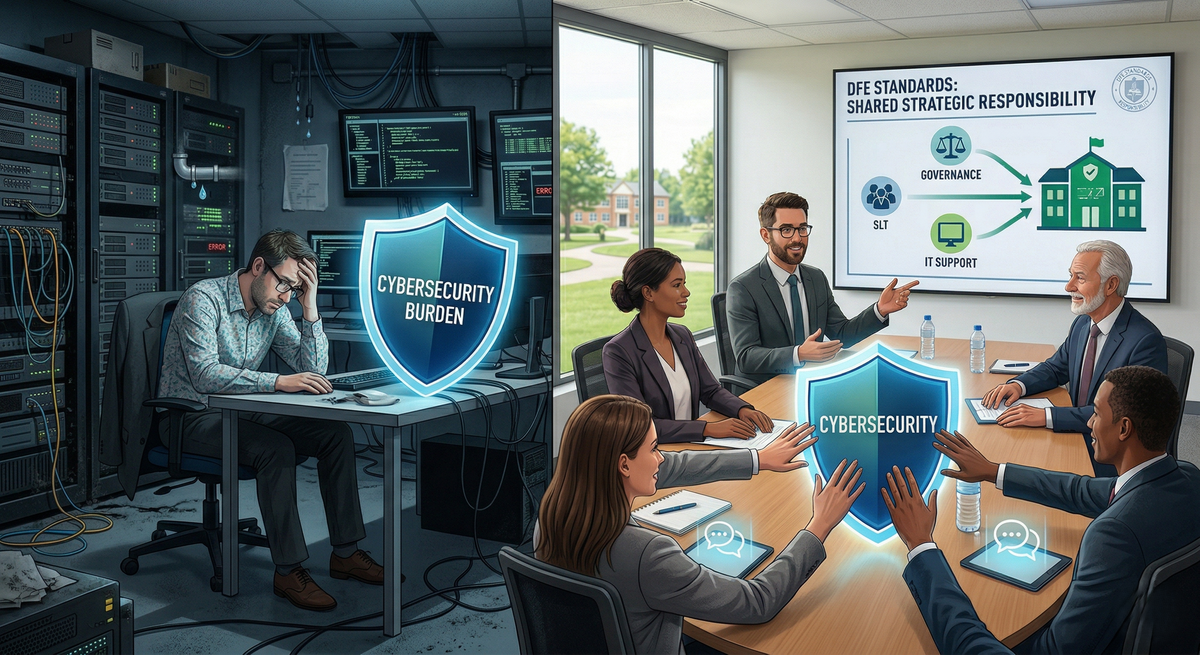
The DfE has updated its digital standards, making cybersecurity a shared responsibility between SLT and IT. By removing technical jargon, the government has given IT the leverage to make digital resilience a whole-school cultural priority, ending the era of the isolated IT team holding all the risk.

The 60-second Briefing
- The DfE has quietly updated its digital and technology standards for schools and colleges, fundamentally altering accountability.
- Cyber security and filtering are now officially defined as a shared strategic responsibility across the entire leadership team.
- Technical jargon has been deliberately removed from the guidance to make the standards accessible and actionable for governing boards.
- IT Directors must use this shift to force schools to treat digital resilience as a human and cultural issue, rather than a technical one.
- Boards of trustees must now actively review these standards, ending the era of the "black box" IT department.
When I published Beyond Compliance: Practical Cybersecurity for Schools last year, my central argument was entirely straightforward: you cannot buy your way out of a cyber attack with systems alone. True digital resilience is about people, behaviour, and culture. Yet, for years, IT directors in schools have often been left holding the bag, expected to secure the network, patch the servers, and block the threats, while senior leaders have seen cyber risks as a purely technical issue that happens in a locked room down the corridor. It is viewed as the plumbing; no one worries about how it works until it leaks. And if a breach happens, all eyes are on the IT department, regardless of the context.
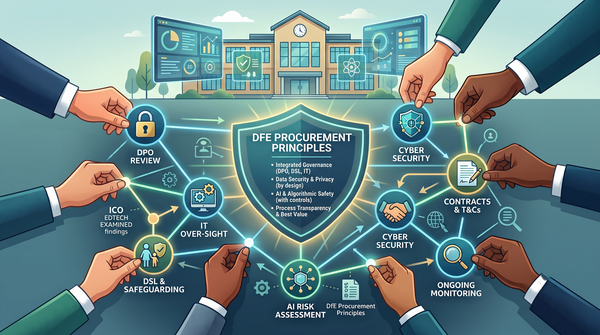
That landscape has just fundamentally shifted. The Department for Education recently updated its Meeting digital and technology standards in schools and colleges guidance. While many in our profession might skim over DfE updates looking for new hardware mandates or specific technical configurations, the most significant change here is not a new firewall requirement. It is a fundamental rewording that explicitly makes cybersecurity, filtering, and monitoring a shared strategic responsibility between the Senior Leadership Team, the governing board, and IT support.
They have stripped out the technical jargon specifically so non-technical staff can understand it. Governing boards and boards of trustees now have overall strategic responsibility for filtering and monitoring and must be assured that the standards are being met. They are explicitly instructed to review the standards and have regular, documented discussions with IT staff. This is not a recommendation; it is an expectation.
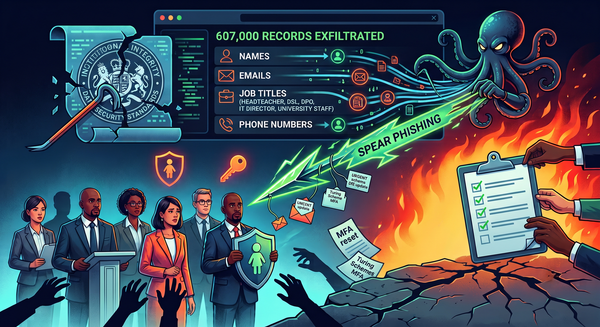
This is the exact leverage many IT staff have been waiting for. SLT can no longer point at the server room, sign off on a £15,000 firewall renewal, and wash their hands of the problem. Managing risk, defining acceptable use, driving staff awareness, and handling the fallout of data breaches are now officially on their desks. The government has realised that a headteacher clicking a phishing link, or a bursar falling for invoice fraud, bypasses the most expensive security appliances on the market. The human element is the primary attack vector, and managing human behaviour is the job of school leadership.
In my post A New Front Line: AI & 'The Com', I pointed out that cybersecurity is a psychology game as much as a technical one. We must train our staff to spot social engineering. The updated DfE standards firmly validate this stance. For IT directors, this means a significant change in how we operate. We must stop acting as isolated, defensive technicians trying to hold back the tide on our own. We need to step into the boardroom and actively guide our bursars and headteachers through this process.
If getting your SLT to take cybersecurity seriously is still a challenge for you, print out the new DfE standards, highlight the sections on shared responsibility, drop them on the Head's desk, and schedule a meeting. You must translate cyber risk into business risk. Stop talking about packet loss, malware variants, and zero-day exploits. The board does not care, and they do not understand. Start talking about operational downtime. Ask the Head how the school will function on a Tuesday morning if the MIS is locked, the door access control systems are offline, and no one can access their emails. Talk about reputational damage. Discuss the inability to process payroll and the very real threat of massive GDPR fines from the ICO. Paint a vivid picture of the fallout.
If your school is still treating digital security as an IT-only problem, you are not just behind the curve; you are now failing to meet basic DfE expectations. We need to force a cultural shift. We need to reallocate budget away from shiny, unnecessary hardware and put it into robust staff training, independent security audits, and table-top incident response exercises with the entire SLT. It is time to stop justifying our existence and start holding the rest of the school accountable for their digital behaviour. The burden is finally shared, and we must make sure the leadership team understands exactly how heavy it is.
See you in the digital staffroom.
To help you force this conversation at your next board meeting, I am giving away a free Cyber Incident Table-Top Exercise when you subscribe to the blog. Download it here: SLT Table-Top Cyber Incident Exercise