Facing the Deepfake Threat: Why IT Must Step into the Classroom
The government’s new digital safety strategy and upcoming RSHE lesson plans force schools to confront synthetic media. While banning phones protects focus, blocking network URLs cannot stop AI manipulation. IT must partner with pastoral staff to teach the actual mechanics of digital deception.

The 60-second Briefing
- The government has published its comprehensive "A Safe, Informed Digital Nation" action plan to combat online harms.
- New statutory RSHE lesson plans focusing specifically on deepfakes and synthetic media are rolling out to secondary schools.
- We must draw a sharp line between banning physical devices in classrooms to aid focus, and the futility of trying to block AI content on a network level.
- The national safeguarding strategy is moving from basic web filtering to active, robust media literacy education.
- IT teams must step out of the server room and directly support pastoral staff in understanding and delivering these complex technical concepts.
In my recent post on how Ofsted and the Independent Schools Inspectorate evaluate technology, I noted that the conversation has firmly moved away from hardware provision. Inspectors are now actively looking at how we manage the psychological and ethical impacts of the digital world on our pupils. We have established that IT departments must become strategic academic partners, enforcing strict procurement rules to ensure we only buy tools that introduce desirable difficulty, rather than metacognitive laziness. Now, we have to apply that strategic mindset to the darkest, most complicated corner of our network: synthetic media and AI-generated misinformation.
We have reached the absolute limit of the "block and ignore" approach to network management. For the past decade, school IT strategy regarding harmful content has essentially been a game of whack-a-mole. We block specific URLs, ban social media domains on the school WiFi, and pat ourselves on the back, assuming we have done our job. But anyone who works in a school knows the reality. We spend thousands of pounds on enterprise-grade filtering, only for a Year 9 pupil to effortlessly bypass the lot of it, cheerfully violating the school's strict mobile phone ban at the same time, by just switching to 5G under the desk.
We must draw a sharp line between a physical boundary and a digital filter. Banning mobile phones in the classroom, a move I strongly support, is highly effective because it removes an immediate, physical distraction. It protects a pupil's cognitive focus. However, trying to block an entire category of algorithmic content, like AI image generators or voice-cloning software, on a network level is an entirely different proposition.
You cannot firewall your way out of a misinformation crisis. The tools used to create synthetic media are completely decentralised. They are built into search engines, they are integrated into social media apps, and they run locally on the very devices the pupils carry in their pockets. A motivated teenager will always find a way to generate or view this content. The government has finally recognised that education, not just network isolation, is the only sustainable answer to digital harms.
Recently, the government released the A Safe, Informed Digital Nation policy paper. Among a raft of new media literacy initiatives, Action 16 explicitly details the rollout of new, statutory RSHE lesson plans specifically designed to teach secondary pupils about deepfakes, synthetic media, and AI-generated misinformation. Furthermore, the upcoming updates to Keeping Children Safe in Education (KCSIE) will place a much sharper safeguarding focus on these issues.
This policy shift provides the perfect framework to build genuine digital resilience. It forces schools to confront how manipulated media files are used maliciously to bully, extort, and radicalise young people. We are dealing with targeted harassment campaigns using deepfake imagery of pupils and staff within our own schools. The psychological damage caused by these digital illusions is entirely real, and our safeguarding response must be equally robust.
However, there is a glaring, structural problem with the government's rollout: it puts the burden of teaching highly complex, rapidly moving technology squarely on the shoulders of pastoral staff and RSHE teachers who may barely understand the mechanics themselves. We are asking geography teachers, drama teachers, and heads of year to explain the intricacies of Generative Adversarial Networks to a room full of teenagers who have been using AI voice-cloning software to impersonate the Head since Year 7. It is an unfair expectation, and without the right support, it is a recipe for ineffective teaching.
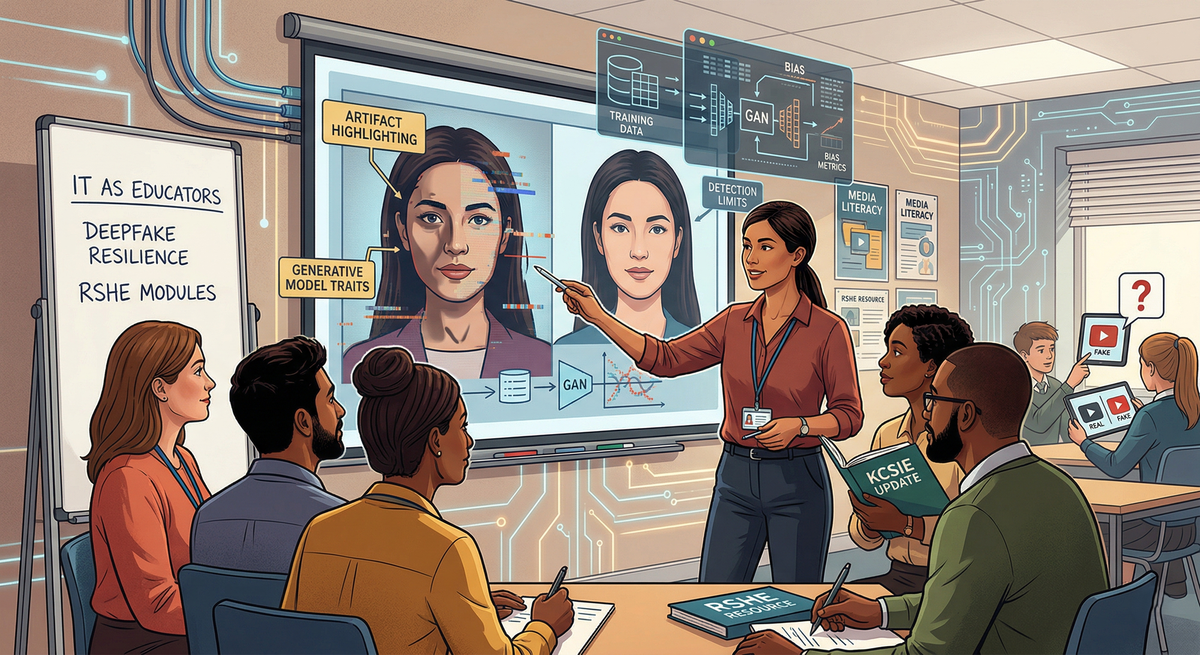
This is where the IT department must step up, change its remit, and get into the classroom. We cannot just maintain the network infrastructure, ensure the Wi-Fi is working, and leave teachers to struggle with digital concepts they do not fully grasp. Telling a pupil "do not believe everything you see on the internet" is an empty platitude. It lacks the depth required to protect them. Pupils need to understand how the technology creates a fake image. They need to understand the data sets used to train these models, the biases inherent within them, and the subtle visual and audio artifacts that reveal a digital forgery.
In my creative writing, when I am working on a script, the golden rule is that you have to deeply understand the underlying motivations of your characters. You have to know their backstory, their flaws, and their objectives. If you do not understand the characters inside and out, the dialogue feels hollow, the audience sees right through the performance, and the entire scene falls flat. The suspension of disbelief is broken.
The same principle applies to teaching media literacy. If our teachers do not genuinely understand the underlying technical mechanics of a deepfake, their explanations will lack authority. The pupils, who are native users of these platforms and often understand the user interfaces better than the adults, will see right through the lesson. Teenagers are highly attuned to adults who are faking technical competence. The moment a teacher struggles for five minutes just to get the interactive whiteboard to turn on, their credibility to lecture on complex AI algorithms vanishes entirely. If they then proceed to simply read from a DfE-mandated slide deck without understanding the content, the pupils will immediately switch off. The lesson becomes an exercise in compliance rather than safeguarding.
We need to get out of the server room and start running intensive workshops for our pastoral staff. We need to break down how generative models work in plain, accessible English, stripping away the panic and the media hype. We need to equip teachers so they can walk into a classroom with absolute, unshakeable confidence.
What does this look like in practice? It means the IT Director sitting down with the Head of RSHE and co-designing the modules. We should be providing real-world examples of synthetic media. We should be actively demonstrating the software used to create these deepfakes so teachers can see the process firsthand. More importantly, we need to explain the limits of current detection tools. We must be honest with our staff and our pupils that there is no magic software that can catch every fake image; human analytical thinking is the only reliable defence.
If a vendor walks into your office promising a deepfake-detection product that solves the problem, they are selling you a story, not a tool.
We have to become the active translators between the raw, complex technology and the pastoral pedagogy. We must explain how social engineering works in an AI-saturated world, where voice cloning can make a scam call sound exactly like a parent or a headteacher. We must teach them about the financial and psychological motivations behind the creation of synthetic media.
If we leave our teaching staff to figure out the complexities of deepfakes on their own, the government's new digital literacy push will fail entirely, and our pupils will remain highly vulnerable to manipulation and extortion. Banning phones in the classroom helps them concentrate on their maths and history, but it does not protect them when they leave the school gates and log onto social media.
As I have argued consistently on this blog, the IT department can no longer act as an isolated service desk fixing broken printers and resetting passwords. We are responsible for the digital architecture of the school, and that includes the cognitive frameworks our pupils use to navigate the internet. We must step out from behind our monitors, partner with our academic and pastoral colleagues, and act like the educators we are. Our pupils' wellbeing depends on our willingness to face this threat head-on, through solid, uncompromising education.
See you in the digital staffroom.