One Desk, Four Crises: The Job Advert That Says It All
The DfE is hiring a Director General for Digital and Infrastructure on its highest-ever salary. The remit – AI, data, cyber, the new child identifier and the school estate, all under one person – signals that government now sees digital and risk as one strategic brief. The org chart has caught up.

The 60-second Briefing
- The DfE is advertising a new Director General for Digital and Infrastructure at up to £200,000 – the department's highest-paid role. Applications close on June 1 2026.
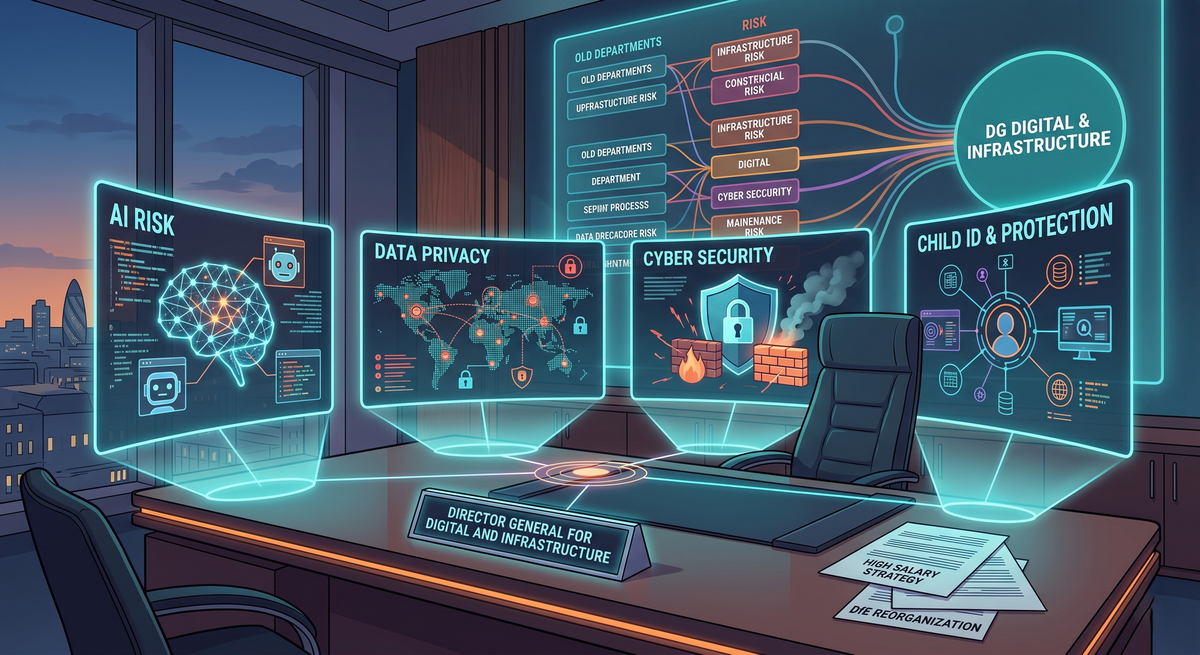
- The remit bundles AI strategy, cyber resilience, education data, the Single Unique Identifier, digital services and the school estate, including RAAC removal, into one brief.
- The post leads a digital, data and technology function of around 1,800 staff.
- The job ad describes "some of the highest levels of risk and accountability in the department, including life-and-death decisions on safety."
- The structure is the argument: government now treats digital, data, cyber and physical risk as one strategic discipline.
I do not normally write about job adverts. But every so often one comes along that says more about where a sector is heading than a dozen policy papers, and the DfE has just published one of those.
The department is recruiting a Director General for Digital and Infrastructure at a salary of up to £200,000. That makes it, according to Tes, the highest-paid role in the department, ahead of the permanent secretary. Applications close on June 1 so, if you fancy it, you have just a few days and presumably a very good answer to "tell us about a time you handled competing priorities."
The salary is not the interesting part, though. The interesting part is the remit, and specifically how much of it sits under one person.
The successful candidate will lead a newly formed Digital and Infrastructure Group, bringing together the DfE's digital, technology, data and analysis functions, a team of around 1,800 people. They will own the department's AI strategy. They will own cyber resilience across the education sector. They will own education data, including the new Single Unique Identifier for children that just became law. And – this is the bit that made me sit up – they will also own the school estate, including the School Rebuilding Programme and the ongoing removal of RAAC, the crumbly concrete that closed school buildings across the country in 2023.
The job advert does not soften this. It describes the function as carrying "some of the highest levels of risk and accountability in the department, including life-and-death decisions on safety." One leader, holding AI, data, cyber and the physical safety of buildings in a single portfolio.
Now, you can read that two ways. The cynical reading is that the DfE has lumped together a bag of unrelated headaches and stuck a big salary on it to attract someone brave enough to take them all on. The generous reading – and the one I think is correct – is that the department has worked out something the rest of the sector is still catching up to: digital, data, cyber and physical risk are not separate disciplines anymore. They are one discipline, and it needs one strategic owner.
If that sounds familiar, it is because I have been making more or less this exact argument since I started writing here. In The End of the Black Box, I argued that cyber risk can no longer be quietly delegated to "the IT person" and forgotten about – it is an institutional risk that senior leadership has to own. In Support Staff: The Engine Room, I made the case that the people running our systems are not a cost centre to be trimmed but the operational backbone of the school. A common thread in nearly everything on this blog is that the IT function is not a service desk that fixes printers and resets passwords. It is a strategic function that owns risk, shapes pedagogy, and increasingly holds the safety of the institution in its hands.
The DfE has just written that argument into an organisational chart and put a £200,000 price tag on it.
Here is why this matters to those of us in schools rather than in Whitehall. The structure of an organisation tells you what it actually values, regardless of what its mission statement says. When a school puts IT a couple of rungs down the hierarchy, reporting to a business manager who reports to a bursar who occasionally mentions it to the Head, that structure is making a statement: technology is plumbing, and plumbing is somebody else's problem until it leaks. When the DfE creates a single senior role spanning AI, data, cyber and estate safety, it is making the opposite statement: this is strategic, this is connected, and it needs to sit near the top.
Many schools are still organised according to the first model. The IT lead is treated as a senior technician rather than a strategic leader, kept busy with the operational and rarely invited into the conversations about risk, pedagogy or capital planning where their expertise is most needed. And yet those same schools are now wrestling with exactly the bundle of issues the DfE has decided needs one senior owner: AI strategy, cyber resilience (and, as The 73% Problem set out, the independent sector carries that risk without a government insurance backstop), data governance for the new Single Unique Identifier, and the perennial question of estate and infrastructure investment.
I am not suggesting every school appoints a £200,000 director general. The budgets discussed in Survival of the Leanest would not stretch to the stationery order for that role, let alone the salary. The point is not the money. The point is the principle. The DfE has decided that digital, data, cyber and infrastructure belong together, near the top, owned by one strategic mind. The question every governing body and SLT should be asking is a simple one: does our structure reflect that reality, or does it still treat the person who understands all of this as the one we call when the projector won't turn on?
The honest answer, in a lot of schools, is the projector. And that is a structural problem no amount of individual brilliance from your IT lead can fix, because you cannot strategise your way out of an org chart that has decided you are support staff.
Whoever takes the DfE role is going to have a genuinely difficult few years. AI strategy alone would be a full-time job; bolting cyber resilience, a national child identifier and life-or-death decisions about concrete onto the same desk is either visionary or slightly mad, and we will not know which for a while. But the act of creating the role tells us something useful regardless of how it plays out. The people designing the national education system have concluded that the digital and the physical, the data and the risk, all belong in the same strategic conversation.
That is the conversation some of us have been trying to drag our sector into for several years. It is oddly satisfying to see it land, at long last, in a job advert.
See you in the digital staffroom.