Survival of the Leanest: Building a Digital Spine in the VAT Era
Independent schools face a 35% rise in operating costs since 2023. Relying on "hope-based budgeting" and historic prestige is no longer a viable strategy. To justify the 20% VAT premium, schools must build a "digital spine" that converts siloed data into tangible proof of value and pupil progress.

The 60-Second Briefing
- The Crisis: Recent reports from NatWest and Landwood Group warn that "fees in advance" buffers are drying up as operating costs per pupil soar.
- The Warning: The closures of historic institutions like Rendcomb College and Alton School prove that prestige cannot override "hope-based budgeting" in the 2026 enrolment window.
- The Solution: Schools must develop a "digital spine" - a unified data layer that connects back-end efficiency with real-time evidence of pupil progress.
- The Opportunity: By adopting AI for repetitive tasks like formative feedback, schools can protect teacher wellbeing and pivot their value proposition toward high-level, human-centric mentoring.
A few weeks ago, a pair of sobering reports landed from the Landwood Group and NatWest regarding the financial health of the UK education sector. If you are on a Senior Leadership Team, the findings make for uncomfortable reading.
According to Landwood’s restructuring advisors, the cumulative impact of the Teachers’ Pension Scheme (TPS) hike, the loss of business rates relief, and the 20% VAT on fees has driven up the operating cost-per-pupil for the average school by roughly 35% since 2023.
But the most telling part of the report wasn't about the tax – it was about "hope-based budgeting". This is the dangerous assumption that historic prestige alone will prevent a drop in pupil intake. We have already seen the cost of this mindset. The shock announcement of Rendcomb College’s closure in January, after 106 years, proves that even established names are not safe if they cannot adapt. They join a growing list of casualties like Alton School and Queen Margaret’s that found themselves on the wrong side of a tight financial window.
The Digital Spine
We are in a new paradigm where parents are value-testing every single penny. They want tangible proof of what that 20% premium is actually buying their child. This is why the NatWest report's call for a "digital spine" is so significant. Without one, you are essentially flying blind into the toughest enrolment cycle in modern history.
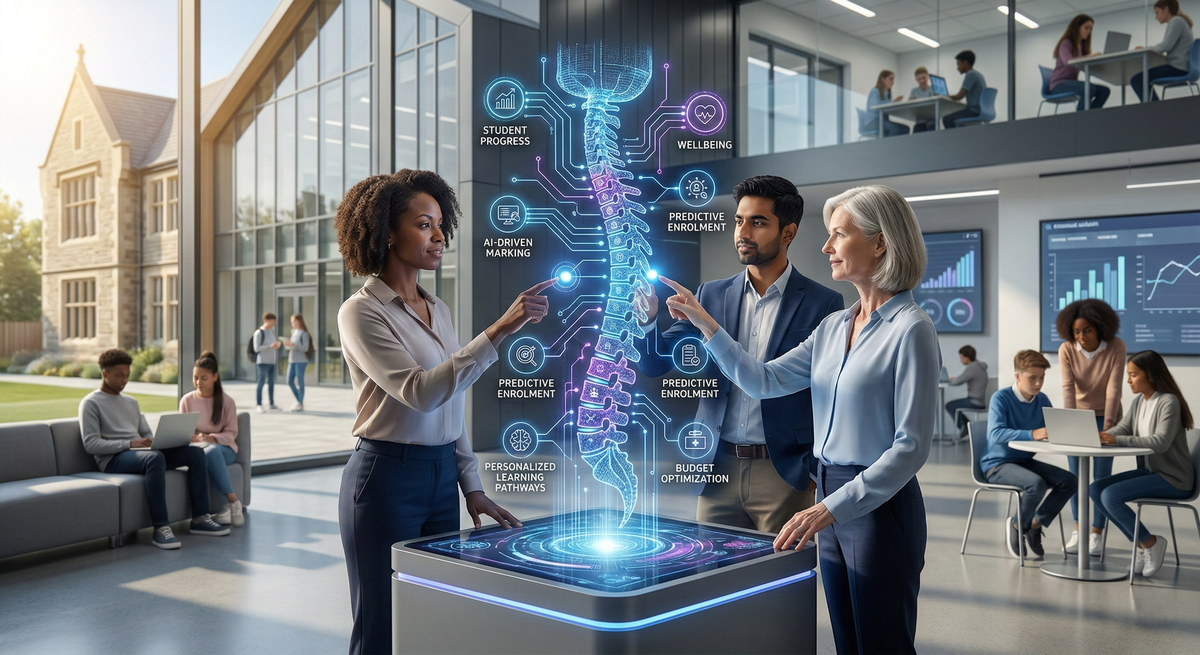
Imagine a school as a physical body. Every interaction – a pupil’s AI-marked essay, a safeguarding note, or a dip in attendance – is a nerve impulse. The digital spine is the central nervous system that carries those signals to the brain (the SLT). Without it, the school is essentially paralysed; the brain has no idea what the limbs are doing until it is too late to react. In a school, this spine bridges the gap between back-end infrastructure and the parental experience. It strips away administrative friction while providing the real-time evidence needed to instantly prove a pupil's progress and wellbeing to a parent who is, quite rightly, questioning their investment.
Flipping the Script on IT
Too often, the IT budget is viewed as a frustrating cost centre, a black hole for WiFi licences and server upgrades. It is time to flip that logic.
Look at the state sector: the DfE is currently tendering to co-create AI tutoring tools for 450,000 pupils by 2027. They have realised that AI is the only way to deliver high-quality, personalised support at scale.
If the state sector is using AI to drive this level of efficiency and close the attainment gap, why aren't we aggressively adopting the same logic to justify our fees?
I call this Survival of the Leanest. Being lean does not mean cutting staff or stripping back the curriculum. It means ruthlessly eliminating administrative friction so that our most expensive and valuable assets, our teachers, can actually teach.
Consider the innovative pilot recently launched by the NCFE and Surpass Assessment. They are trialling AI-assisted marking and feedback tools designed to give learners immediate, high-quality formative feedback in seconds, while significantly reducing the marking workload for educators.
This is the good news we should be capitalising on. Imagine being able to tell prospective parents that their child will receive instant, AI-driven formative feedback on their practice essays every single night, while your expert teaching staff use the saved hours to focus on complex, nuanced, face-to-face pastoral and academic mentoring. That is a value proposition that justifies a premium fee.
When we use technology to absorb the foundational, repetitive tasks, we protect teacher wellbeing. And in the current market, retaining brilliant teachers is a huge competitive advantage.
Survival of the Leanest
Without a digital spine, AI tools are just more siloed tech. You need the infrastructure to feed those AI insights back into a central system so that the SLT can actually prove the value at the end of the term.
The schools that survive the 2026 enrolment cliff-edge will not be those that simply hiked their fees and crossed their fingers. They will be the leanest, most data-agile institutions. They will be the schools that abandoned hope-based budgeting, built a robust digital spine, and used technology to amplify the human expertise in their classrooms.
It is time to stop viewing the IT budget as a necessary evil and start viewing it as your primary survival tool.
See you in the digital staffroom.