The Artificial Advantage: Why 2026 Feels a Lot Like 2020
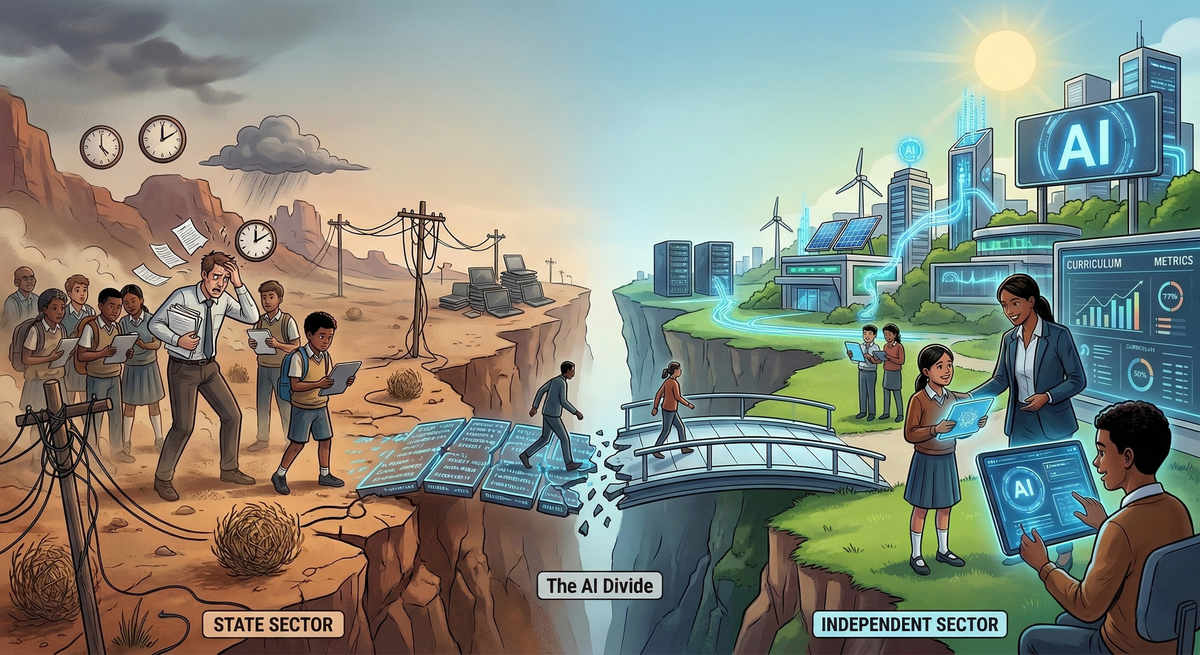
Nick Harrison of the Sutton Trust warns we are entering a "digital Wild West" where a new AI divide is widening between state and independent sectors. As we look at the data, it is impossible not to draw close parallels to the hardware-access crisis we faced during the pandemic.

The 60-Second Briefing
- The Training Gap: Teachers in private schools are twice as likely as state peers to have received formal AI training (45% vs 21%).
- Strategy Vacuum: Only 9% of state schools have a formal AI strategy, compared to 27% in the independent sector.
- A "Wild West": The Sutton Trust warns that without government intervention, AI will become a major barrier to opportunity rather than a bridge.
- Pandemic Echoes: This shift mirrors the 2020 digital divide, but where we once fought over laptops and 4G dongles, we are now fighting over AI literacy and "human capital."
Thinking about staff AI training during a recent CPD afternoon, I couldn't shake a nagging sense of déjà vu.
Back in 2020, when I was Chair of Governors at a state school, I had a phone call with one parent who was trying to manage three children's remote learning on a single pay-as-you-go smartphone. They were taking turns squinting at a cracked screen just to read a worksheet. That was the moment the gap became real to me – it wasn't just a missing device; it was a total lockout from learning.
Today, the audit has changed, but the underlying anxiety remains the same. A recent report from the Sutton Trust, Artificial Advantage?, confirms that we are sleepwalking into a new kind of inequality. It describes the current landscape as a "digital Wild West" where the type of school a child attends determines their access to the defining technology of our era.
The pandemic taught us that a "digital divide" usually meant a lack of physical devices. I remember the scramble for refurbished laptops and the struggle for data-free SIM cards for our most disadvantaged families.
However, the 2026 divide is not about who owns the tablet; it is about who knows how to use the "intelligence" inside it. The Sutton Trust found that teachers in our sector are twice as likely to have had formal AI training compared to state school colleagues (45% vs 21%). We are also three times as likely to have a coherent, school-wide strategy for how AI fits into our curriculum (27% vs 9%).
As an IT Director, I see the "artificial advantage" most clearly in the staffroom. Teachers are increasingly using AI to handle the heavy lifting – writing reports, drafting lesson plans, and creating custom assessments.
Call it Admin Wealth. It is not money in the budget, but it is the next best thing: hours back in the working week. Where parents pay fees, those hours flow into pastoral care, one-to-one mentorship, and the kind of bespoke feedback that makes our prospectus claims actually true. Where the school is cash-strapped and time-strapped, those hours never materialise at all. The teacher carries the same workload, only without the AI scaffolding to ease it.
Admin Wealth compounds, just like financial wealth: the schools that have it use it to deliver a better experience, which attracts a better-paid intake, which funds more training, which generates more Admin Wealth. And like financial wealth, it does not redistribute itself.
You can see it in the habit data. It isn't just that our teachers have had more training; they are using these tools more often. The Sutton Trust found that private school teachers are more likely to reach for AI at least once a day than their state counterparts (18% vs 11%). Training plants the seed, but daily use is where the time savings actually accrue, and where the gap quietly widens every single working day.
In contrast, only 11% of teachers in schools rated 'Requires Improvement' or 'Inadequate' by Ofsted have received formal AI training. They are facing the same workload crisis, but without the strategic support or tools to solve it, further widening the gap in pupil experience.
We should have seen this coming. During the pandemic, access to personal devices was universally acknowledged as fundamental to success, yet many young people were deterred from even applying to university due to digital exclusion.
We are now seeing the same pattern repeat with generative AI usage, which has spiked from 53% to 88% of undergraduate students using GenAI for assessments in just one year, according to HEPI's 2025 survey.
Disadvantaged pupils are already more likely to use AI ineffectively, often just to bypass work rather than deepen their learning. Without the deliberate intervention of a "data coach" teacher, these pupils are not gaining literacy; they are outsourcing their education.
I believe that for those of us in the independent sector, this isn't just an operational win; it is a moral burden. We have the resources to be the test pilots for responsible AI integration, but we cannot fly solo.
The DfE's recent £23m investment in EdTech Testbeds is a welcome signal that the government wants evidence over marketing hype. So is the refreshed AI training package the DfE put out this May, which bundles free modules and dedicated leadership guidance that any school can pick up and run with. Notably, it costs a cash-strapped school nothing but time. The catch, of course, is that time is the one thing the under-resourced schools do not have – which is rather the point. Free materials only close the gap if the schools that most need them have the capacity to use them.
But as leaders, we must ensure our strategy doesn't end at the school gates. We should be advocating for a "joined-up" response that provides every Pupil Premium recipient with the devices and guidance they need to compete in an AI-driven labour market.
The pandemic proved that when technology adoption is rushed and unequal, the poorest children suffer the most. We are now at a moment of change where AI literacy is becoming a core component of digital citizenship.
My advice to my peers this month is simple: don't just focus on the "what" of your AI strategy. Focus on the "who" and ensure your school's advantage doesn't become another child's barrier.
See you in the digital staffroom.