Sweden Hasn’t Banned EdTech, They Have Simply Set Standards
Headlines claim Sweden is tearing out all school technology and reverting entirely to textbooks. The reality is far more nuanced. While early years are ditching screens, secondary education is enforcing intentional tech use, demanding evidence of impact - a move the UK is also adopting.


The 60-second Briefing
- Sweden has completely removed devices for Nursery and Reception pupils.
- Years 1 to 7 are replacing default screen time with traditional printed textbooks.
- Years 8 to 13 are keeping laptops, but shifting focus to enhancement rather than default use.
- A ban on mobile phones during the school day has been introduced across the board.
- The UK government’s recent £23m EdTech Testbeds expansion mirrors this push for genuine, evidence-based tech integration.
- Recent Harvard research highlights why intentional, pedagogical use matters infinitely more than raw screen time.
It is incredibly easy to read a headline and immediately jump to the most extreme conclusion. When the BBC reported this week that Sweden’s schools are cutting back on digital learning, a predictable wave of validation washed over the anti-tech crowd. A narrative was instantly set: the Scandinavian digital utopia has collapsed, the grand EdTech experiment has failed, and we must immediately remove devices from the classroom.
Let us stop and take a breath. If you actually read past the headlines and look at the underlying policy details, Sweden is not declaring an absolute war on computers in schools. They are executing a massive, necessary reset, moving away from a blind, unquestioning faith in digital-first education and shifting toward a model of intentional, pedagogical value.
Frankly, it is a move that every school in the UK should study closely, because Sweden is finally adopting the exact 'intentional tech' strategy that good academics and pragmatic Senior Leadership Teams have been demanding all along. While it is often individual teachers or departments who get swept up in the latest EdTech hype, lured by free trials and promises of instant pupil engagement, good IT Directors have always stood shoulder-to-shoulder with SLT on this issue. We demand solid proof of pedagogical or business value before signing the purchase order or making changes to the network. Sweden is simply writing that standard into national policy.
The most aggressive part of the Swedish policy applies to the youngest learners. For their equivalent of Nursery and Reception, devices are gone completely. For Years 1 to 7, schools are actively replacing digital devices with physical textbooks. From a developmental standpoint, this is entirely logical. I personally have a deep love for books and reading. There is something fundamentally grounding about the tactile experience of holding a physical book, feeling the weight of the pages, and tracking a sentence with your finger. Back in the day, I had to spend hours learning proper penmanship, carefully forming letters on paper until my hand cramped. It felt tedious at the time, but the physical act of handwriting and the focus required to read printed text without the constant temptation of a screen are fundamentally important for early cognitive development.
We have known for a long time that throwing a tablet at a six-year-old does not magically make them a better reader. The brain processes information differently on a screen, often skimming rather than deep reading. The friction of the physical page forces the brain to slow down and absorb the material. Removing devices from this age group is not a technological regression; it is a pedagogical correction.
However, the picture changes significantly when you look at secondary education. For Years 8 to 13, the messaging from Sweden is not hugely different from the UK government announcements we saw earlier this year, nor is it different from the internal policies many of us are already enforcing. Laptops and tablets are not being banned for teenagers. The focus has simply shifted to ensuring the technology actually improves lessons and outcomes.
At the Bett UK Conference in January, Education Secretary Bridget Phillipson announced a £23 million investment to expand the government's EdTech Testbeds pilot programme into a four-year initiative. The entire purpose of that government funding is to put the latest tech and AI tools through their paces in classrooms to generate genuine evidence about what actually works. The DfE wants to track how these tools perform, the difference they make for teachers, and whether they actually help pupils. This is exactly what Sweden is doing. They are demanding evidence.
The expectation for older pupils is that the laptop is now used mainly as an enhancement tool. It is there for complex research, coding, computer science, and data analysis. It is no longer the default medium for simply filling out a digital worksheet or reading a PDF that could easily have been printed. Just as a good editor mercilessly cuts any text that does not advance the plot, schools must cut out any technology that does not actively advance the learning process. The device must earn its place on the desk by providing an experience that cannot be replicated with a pen and paper. If a school buys a £1000 laptop just so a pupil can type an essay into a word processor instead of writing it in an exercise book, that is a colossal waste of money and a complete misunderstanding of what technology is for.
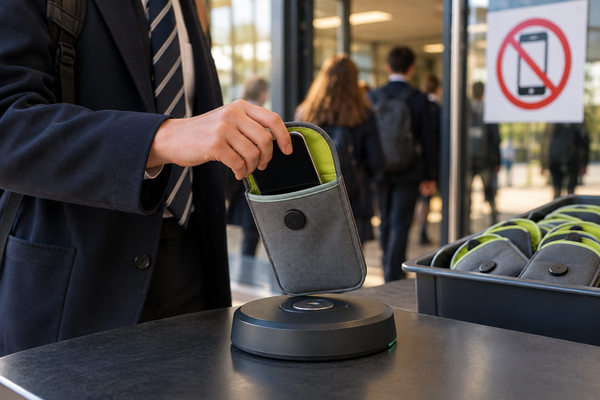
Alongside this refinement of laptop use, Sweden has implemented a blanket ban on mobile phones during the school day across all compulsory education. This is not a controversial, anti-technology stance. It is basic common sense, entirely aligned with what we are currently doing in the UK, and a move I support. Mobile phones are engineered distraction machines; they have absolutely no place in a working classroom.
As I wrote earlier this year in Banning Devices, Building Minds, the debate should never be a binary argument about whether tech is inherently "good" or "bad". Technology is entirely neutral. The outcome depends entirely on how we choose to deploy it. Banning smartphones while simultaneously teaching complex data analysis on a laptop is not a contradiction; it is the definition of intentionality.
This entire situation mirrors a much wider global debate about the efficacy of classroom technology. Earlier this year, Dr. Jared Cooney Horvath, a neuroscientist and educator, delivered a highly publicised testimony before the US Senate Committee on Commerce. He argued forcefully that the billions spent putting laptops and tablets in schools has effectively created a generation less cognitively capable than their parents. He pointed out that digital platforms are heavily engineered to capture attention, fragment focus, and accelerate task switching. These are the exact opposite conditions required for deep learning and long-term memory retention.
Dr. Horvath’s assessment is harsh, but he makes a valid point: when general-purpose screens are used indiscriminately in core academic contexts, they often slow learning and weaken retention. A browser tab offering a complex algebraic equation simply cannot compete with the dopamine hit of the adjacent tab offering a YouTube video. But even he adds a necessary caveat, noting that in certain circumstances, like tightly constrained adaptive practice and targeted remediation, digital tools do support skill acquisition. The problem is not the silicon and the plastic. The problem is how loosely and poorly we deploy it, assuming that proximity to a screen equals proximity to knowledge.
This brings us to the counter-balance in the current technological landscape. If general-purpose screens are causing harm, what happens when we use highly intentional, pedagogical technology? A recent Harvard University study, published in Nature Scientific Reports, provides a fascinating answer. Researchers ran a randomised controlled trial comparing physics pupils learning from an AI tutor against those in a standard active learning classroom. The results were staggering: the group using the AI tutor more than doubled their learning gains while spending less time on the tasks. Furthermore, they reported feeling more engaged and motivated.
The key to the Harvard study is that the researchers did not just give the pupils access to a generic, off-the-shelf chatbot. They engineered an AI tutor specifically to follow pedagogical best practices. The software provided scaffolding, managed cognitive load, gave immediate and highly personalised feedback, and allowed for self-pacing. It offered the kind of infinite patience and targeted tutoring that simply cannot scale when you have one human teacher managing a class of thirty teenagers.
This research perfectly illustrates the central argument I made recently in Curiosity vs. the Clock. The national debate around technology in schools is entirely trapped in a lazy mindset. We are absolutely obsessed with raw "screen time" as the ultimate metric of pupil wellbeing and academic success. But measuring screen time is a blunt, outdated instrument that tells us nothing about the quality of the interaction.
As I noted in that post, when a teenager makes a breakthrough in science or coding, no one complains about how many hours they spent looking at a monitor. The medium is not the message. Spending four hours mindlessly scrolling through short-form video content is incredibly damaging to a pupil's attention span and mental health. Spending four hours building a Python script, or engaging with a pedagogically designed AI tutor that challenges their assumptions and forces them to think deeply, is a massively productive use of time. Conflating the two simply because they both happen on a piece of glass is entirely unhelpful.
Sweden is not abandoning technology; they are abandoning the lazy assumption that simply placing a screen in front of a child constitutes an education. They are demanding that the tools we use have a clear, demonstrable purpose and are backed by genuine evidence. This is the definition of intentional technology, and it maps perfectly onto the framework that effective independent schools are already building.
For IT Directors and senior leadership teams, this should be a moment of absolute clarity. We need to stop chasing the hype cycle. When an enthusiastic head of department comes to us demanding the latest software platform they saw heavily marketed on social media, we must be the ones to apply the brakes. We have to act as the strategic filter, ensuring that every piece of software and hardware aligns with the school's core academic goals.
We need to sit down with our academic deputies and insist that teaching staff justify the educational value of every app, platform, and device they want to deploy. We have to ask the hard questions: What specific problem does this solve? How does it improve the lesson beyond what a textbook can do? How will we measure its success?
If a piece of software merely digitises a bad worksheet, get rid of it and buy a textbook. If a laptop is only being used as an expensive typewriter, close the lid. But if a platform provides targeted, intelligent feedback that a teacher simply does not have the hours in the day to give, or if a device allows pupils to analyse complex datasets that they could never process on paper, then we must champion it, fund it, and support it fully. Sweden has finally realised that the novelty of the digital classroom has completely worn off. Schools in the UK should follow suit and start treating educational technology with the rigour, scepticism, and intentionality it actually requires.
See you in the digital staffroom.