Notes from the First AI-Aware Exam Results Week
The widest regional divide the modern GCSE grading system has ever produced. Independent schools' top grades fell slightly while state schools held steady. UCAS warned students about AI misinformation on results day itself. This may be the first genuinely AI-aware results week.

The 60-second Briefing
- GCSE results were published on August 20, following A-level results on August 13.
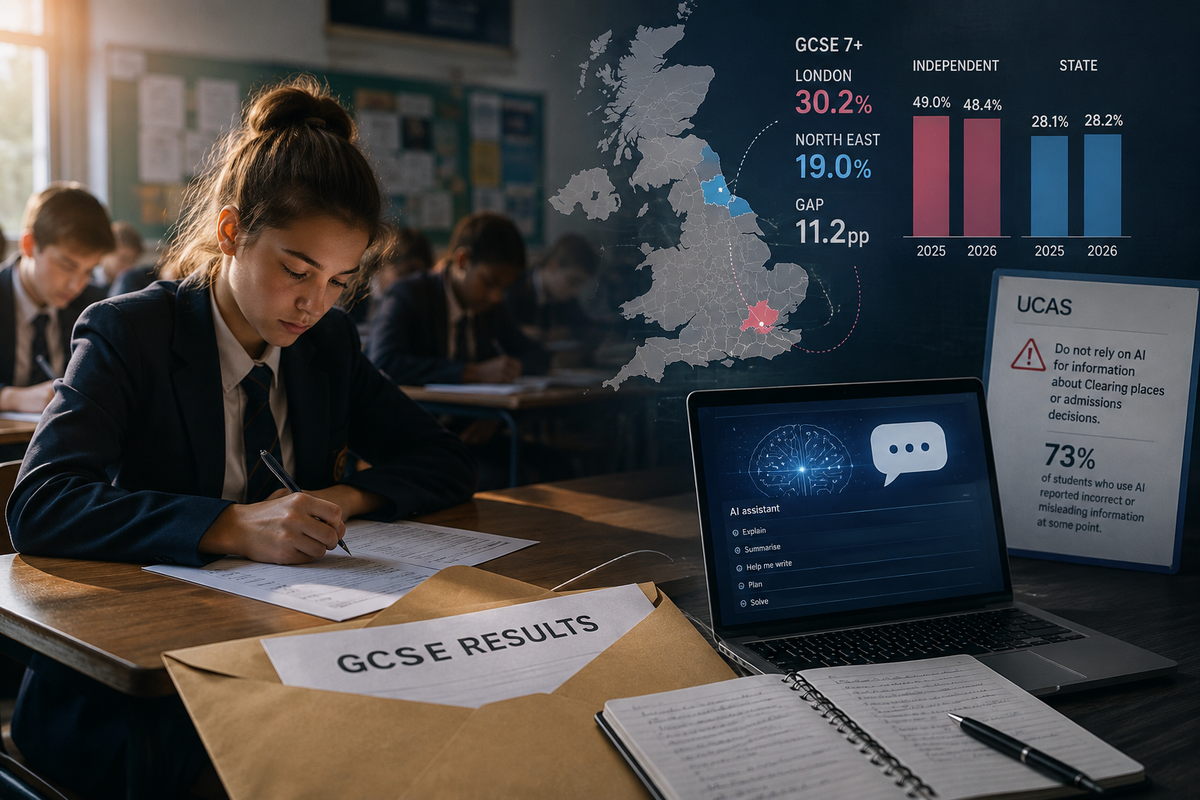
- Top grades (grade 7 or above) were 22.0% in the UK, marginally up from 21.9% in 2025. The pass rate at grade 4 fell slightly to 67.3%.
- Independent schools' top grades fell from around 49% to 48.4%. State-funded schools improved by 0.1 percentage points. The independent-state gap narrowed for the first time in several years.
- The regional gap widened: 30.2% of London GCSE results were awarded grade 7 or above, compared with 19.0% in the North East.
- On A-level results day itself, UCAS published an unusual warning that pupils should not rely on AI for information about Clearing places or admissions decisions. Their own data: 73% of pupils who use AI reported receiving incorrect information at some point.
Results week has ended. Both A-levels and GCSEs have been through the process, the newspapers have run the photographs of pupils opening envelopes with either delight or careful composure, and the trade press has settled on the standard summary: Broadly stable results. Slight adjustments at the margins. Normal service resumed after five years of pandemic-era disruption.
That summary is technically accurate, but quietly misses something about the 2026 numbers - three specific data points that, together, paint a picture that is more interesting than any of them separately.
The independent-state shift
In its results day briefing, Ofqual noted that in state schools, results at grade 7 and above improved very slightly compared with last year, up 0.1 percentage points. In independent schools, results at grades 7 and above fell by 0.5 percentage points. Schools Week broke this down further, noting that private school top grades fell from 49% to 48.4%. Small numbers, but real direction.
For most of the past decade the independent-state gap has widened, not narrowed. This year it narrowed. It is a single data point, statistically noisy, and there are several perfectly plausible explanations that have nothing to do with the argument I am about to make. It might have to do with the composition of the cohort. Or the subject entry patterns. Maybe Ofqual's grade boundary adjustments in maths this year, which affected schools differently depending on their subject mix. Perhaps the continuing VAT-era movement of pupils between sectors, which changes the profile of both intake groups. Any of these could have influenced the outcomes, and several of them probably did.
But the direction is worth noting. If the schools with the deepest AI integration are seeing marginal declines in top-grade outcomes while the schools with the shallowest AI adoption are seeing marginal improvements, that is exactly what the leading edge of the cognitive-offloading argument would look like if it were starting to show up in the exam hall. It is not yet a headline or a scandal; just a quiet, boring reversal of a trend that had been going the other way for years.
Now, I accept that a single year does not establish causation. The independent sector could have a much stronger year in 2027 for reasons that have nothing to do with AI. But 2026 is the first year where the two things could plausibly be connected, and the question is worth asking out loud rather than assuming it away.
The evidence base backing the question has expanded considerably in the last twelve months. The OECD's Digital Education Outlook 2026 found that pupils using AI on tasks performed 48% better on those tasks and 17% worse once the tool was removed. The EEF opened a formal research call in June on the cognitive impact of generative AI in pupils aged 13 to 15. The DfE's own Generative AI Product Safety Standards now require reporting on the rate of cognitive offloading requests. Wensleydale School's AI marking pilot showed the promised time savings did not materialise.
None of this proves the independent-schools shift is AI-related. It just means the question is now serious enough that a serious answer needs consideration.
The regional gap
The second data point is Ofqual's regional breakdown. 30.2% of GCSE results in London were awarded grade 7 or above. In the North East, the same figure was 19.0%. That is an 11.2 percentage-point gap, and it is the widest regional divide the modern GCSE grading system has ever produced.
That gap should not surprise anyone who has read the Sutton Trust's Artificial Advantage report, or the piece I wrote about it earlier this year. It is the operational shape of an educational system where access to enrichment, tutoring, cultural capital, and now AI-augmented preparation is very unevenly distributed by postcode. What is worth noticing is that the gap widened rather than narrowed in a year when the government made its biggest push on enrichment equity through the Every Child Can programme.
The Every Child Can rollout is early, and much of its funding does not touch classrooms until September onwards. So the 2026 gap does not tell us whether the intervention will work. But it does tell us the starting line, and the starting line is further apart than it was.
The UCAS AI warning
On A-level results day itself, on the morning when thousands of teenagers were making decisions about their next steps, UCAS published an unusual warning: pupils should not rely on AI for information about Clearing places or admissions decisions. The statement noted that 73% of pupils who use AI reported having received incorrect or misleading information from it at some point. UCAS advised treating AI as a starting point for research rather than as a decision-maker.
A statutory admissions body issuing that warning at that moment is not a small thing. Six months ago the debate about AI in the admissions process was mostly about universities detecting AI-generated personal statements. Twelve months before that it was about whether pupils should be using AI to prepare for interviews. Both are still going on. But UCAS's warning is a public acknowledgement that the tools being sold to pupils and their parents as universally helpful are, on the admissions body's own numbers, being wrong most of the time for most of the people using them.
That has direct implications for schools. Careers offices, sixth-form staff, and Heads of Year 13 will spend September fielding questions from pupils and parents about Clearing decisions, adjustment options, and reapplication strategies. Any of those conversations that rest on AI-generated information rather than school-mediated advice is now, per UCAS itself, likely to be based on partially incorrect facts. The value of a well-briefed careers office has just increased. So has the workload.
The wider picture
Read those three data points together and 2026 is something more than a stable results year. It becomes the first year in which AI has been a character in every dimension of results week. In the coursework preparation that fed into the papers. In the personal statements universities are increasingly running through AI-detection tools. In the Clearing information pupils are being warned not to trust. And, quietly, possibly, in the grade distribution itself.
The story is more interesting than the two loudest predictions from either direction. It is not the AI cheating scandal that some news outlets have been waiting for. It is also not the AI-transforming-education triumph that the more enthusiastic EdTech advocates keep announcing. It is a picture in which AI is genuinely everywhere in the process and the effects are showing up unevenly, sometimes usefully, sometimes not, and occasionally in ways that reverse the trends the sector had been expecting.
What to watch for next year
Three things, in ascending order of importance.
Grade boundary adjustments. Ofqual made targeted changes in maths this year and may make similar adjustments elsewhere in 2027. Watch which subjects move.
The EEF's interim findings. The cognitive offloading research call closed for expressions of interest at the end of June, with projects starting in November. First interim outputs may arrive in late 2027, which is early enough to inform the following results year.
And the independent-state gap. If the 2026 shift was noise, next year should see it reverse or hold steady. If it was directional, the gap will keep narrowing. Neither outcome proves anything conclusive. But the two data points together, if they exist, would be worth pausing on.
The exam hall is one of the few places in education where the "AI helps you look good but not learn well" thesis can be empirically tested at scale. Results week is that test, once a year, at population level, with the full weight of a national grading system behind it.
The 2026 numbers do not settle the argument in either direction. They add one data point to it. And the direction of that data point, on its own and read alongside everything else this summer, is worth noting quietly, without over-claiming.
Careers offices should be very well prepared this September. Boards should be asking careful questions about which of their AI investments are earning their place. And the sector should be watching next August's numbers with more interest than usual.
See you in the digital staffroom.