The Pouch Question: What the Yondr Surge Says About Phone-Free Enforcement
Schools have moved fast on the KCSIE 2026 phone-free-by-default position, and Yondr pouches are the enforcement product of choice. At £20 to £25 per pupil per year, the question worth asking is whether the product actually delivers on the enforcement promise.

The 60-second Briefing
- Tes reported on September 16 that schools are moving quickly to lockable phone pouches, with Yondr the dominant supplier, following the September 1 activation of KCSIE 2026's phone-free-by-default position.
- The Children's Wellbeing and Schools Act 2026 gave the guidance statutory weight from June 29. Schools now have a legal duty to have regard to guidance that says all schools should be mobile phone-free environments by default.
- Yondr pouches cost £20 to £25 per pupil per year, per industry reports, and the company secured $19 million in K-12 US sales in 2025.
- Known workarounds include hitting pouches at a specific angle to force them open, using cheap magnets available online, and inserting flat rectangular rocks as decoys.
- Some US schools that trialled Yondr have discontinued it in favour of simpler "off and away" policies, describing the pouch process as an extra step that was not necessary.
Since the beginning of September, when the KCSIE 2026 phone-free-by-default position took effect, a specific procurement question has been landing on the desks of IT directors and bursars. Should the school be buying Yondr pouches? A neighbouring school has ordered them for the term, a bursar has been quoted around £20 per pupil, and the SLT wants to know whether to follow.
The short answer is: probably not, and here is why the question deserves a post rather than a one-line reply.
What has actually happened this term
Yondr, the American manufacturer of magnetically locked fabric pouches, has become the default answer to the enforcement question. Tes reported on September 16 on a surge in secondary schools adopting the pouches over the summer, timed to the September 1 activation of KCSIE 2026's phone-free-by-default position. The Children's Wellbeing and Schools Act 2026 gave the guidance statutory weight from June 29, meaning that a school operating anything other than a phone-free position has to be prepared to justify it as an exception. That is a real change from the position most schools were operating under a year ago, and it has understandably concentrated minds.
The company itself has been ready for this moment for years. Yondr was founded in San Francisco in 2014, initially to create phone-free spaces at comedy clubs and concert venues. It has been shipping to schools since 2015, and pouches are now in use by roughly three million pupils across all fifty US states, according to the company's own figures. GovSpend, the public procurement database, records $19 million in K-12 sales in the US in 2025 alone. The UK market has taken longer to move but is now catching up quickly.
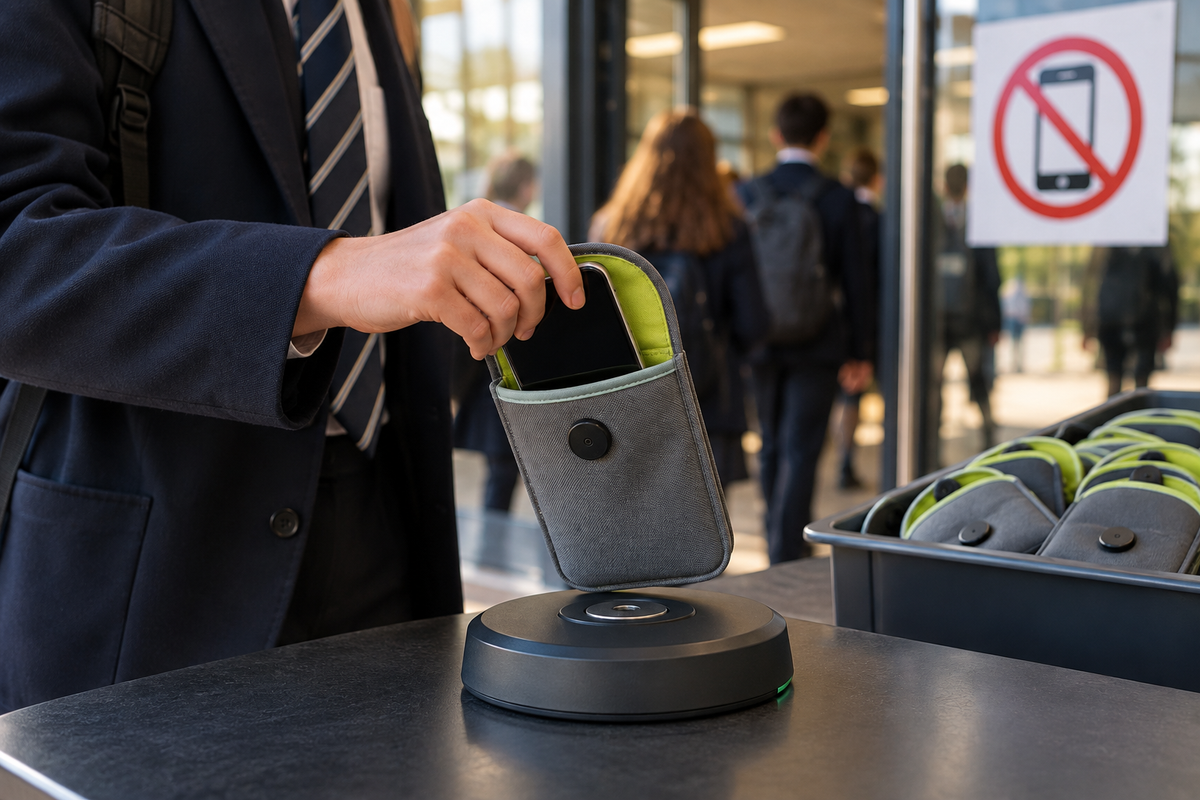
The proposition is straightforward. Each pupil is issued a fabric pouch. On arrival at school, the pupil places their phone into the pouch and closes it. A magnetic lock engages. The pupil keeps the pouch on their person throughout the day. At the end of the day, the pupil taps the pouch on an unlocking base at the school entrance, the lock releases, and the phone is retrieved. In theory, no phone is accessible during the school day without staff intervention. In theory.
The three documented workarounds
In practice, three specific workarounds have been documented well enough to reach mainstream US reporting. In March 2026, the New York Times ran a piece on how the Yondr pouch has actually performed in classrooms since 2023.
The first is mechanical, and one I have personally seen demonstrated. Pupils have found that hitting the pouch against a table or a stair railing at a particular angle causes the lock to spring open. This is not a design flaw that requires ingenuity to exploit. Once one pupil in a school works out the angle, the whole cohort knows within a week.
The second is cheaper and less physical. Small neodymium magnets, the kind used in fridge notice boards, retail online for under £10 and unlock the pouch cleanly. I have tested this one myself, and it does work. The pouch itself uses a magnetic lock, which is the vulnerability. Any magnet strong enough to disengage the mechanism does the job.
The third is deliberately funny and shows how the pouch has been culturally received. Pupils have taken to finding flat rectangular rocks, sliding them into the pouch, and pocketing the phone separately. The rock is heavy enough to feel like a phone through the fabric. Staff checking that the pouch is closed and weighted see what looks like compliance. The phone is in the other pocket, freely accessible.
Any one of the three workarounds is enough to defeat the enforcement value of the pouch. Any school that adopts Yondr in September will, on the evidence of the US experience, be dealing with all three by half-term.
Cost and value
The cost is not trivial. Industry reporting puts the annual per-pupil cost at £20 to £25. For a 900-pupil school that is not passing on the cost, that is £18,000 to £22,500 a year, indefinitely, for the pouches themselves. Add the unlocking stations, the staff time to distribute pouches on the first day of term and to replace lost or damaged ones through the year, and the training time to embed the process. The realistic total cost of ownership sits somewhere between £25,000 and £35,000 a year for a school of that size, depending on how the enforcement architecture is built around the pouches.
That is not a small budget line. It is the same order of magnitude as a substantial safeguarding platform subscription, or a modest network refresh, or a part-time member of pastoral staff. If the school is going to spend that money every year, the question worth asking is not whether the pouches comply with the statutory guidance. Any competent enforcement mechanism does that. The question is whether the pouches deliver on the enforcement promise better than the alternative options at similar or lower cost.
The alternatives
Two alternative approaches are worth putting alongside the pouch, because they are what a number of US schools have moved back to after trialling Yondr.
The first is a strict "off and away" policy. Pupils bring the phone to school, keep it powered off, and store it in their bag or locker throughout the day. Any phone visible or audible during the school day is confiscated and returned only to a parent at the end of the week. The enforcement mechanism is staff attention and consistent application. The cost is zero. The Folsom, California, district that trialled Yondr for the 2023 school year moved back to this approach in 2024, with the principal saying the pouches had turned into "an extra step that we did not find necessary."
The second is a physical collection point. Pupils drop the phone at reception on arrival and collect it at the end of the day. This requires a locker or a labelled tray system and one member of staff briefly at each end of the day. It is not glamorous, and it requires the school to accept some responsibility for the devices in its temporary custody, but it works, and it costs almost nothing beyond the physical infrastructure.
Neither of these approaches is as photogenic as a fabric pouch with a magnetic lock. Both of them, according to schools that have tried both, work better in practice.
Four questions before signing
For any school currently being pitched Yondr this term, four questions are worth putting to the supplier before deciding.
The first is how the company answers the three documented workarounds. If the answer is that the workarounds are pupil misbehaviour rather than product failure, that is a signal about how the enforcement conversations will go through the year.
The second is what the total cost of ownership actually looks like over three years, including replacement pouches, replacement unlocking stations, staff training time, and administrative overhead. The per-pupil figure quoted in the pitch is usually the pouch cost only.
The third is what the pilot data from comparable UK schools actually shows. If the supplier has a pilot in the school's phase and region, the pilot outcomes are worth reading. If they do not, that is a signal that the school is being asked to be the pilot.
The fourth is what happens when a pupil deliberately damages the pouch. Who pays for the replacement, how quickly is it issued, and what is the enforcement mechanism during the interim? A pouch that takes a week to replace is a week of unenforced phone access.
Close
The KCSIE 2026 phone-free-by-default position is a substantive change and it deserves a substantive enforcement mechanism. What it does not deserve is the first substantive-looking product a supplier walks through the door with, on the assumption that spending money is the same as solving the problem.
The procurement discipline conversation this blog has been having all year in the AI context applies just as neatly here. Ask what the product actually does. Ask what it does not do. Ask what it costs over three years. Ask what happens when it fails. If the supplier cannot answer those four questions cleanly, the product is not yet ready for the school's buying, whether it is a chatbot or a fabric pouch.
Fabric pouches with magnetic locks are not the only answer to the phone question. They are one possible answer, at a specific price point, with specific and documented failure modes. Schools should hold that in mind before raising the purchase order.
See you in the digital staffroom.