Jisc in Talks with Microsoft on AI Standards in UK Education; DfE and ICO Also Involved
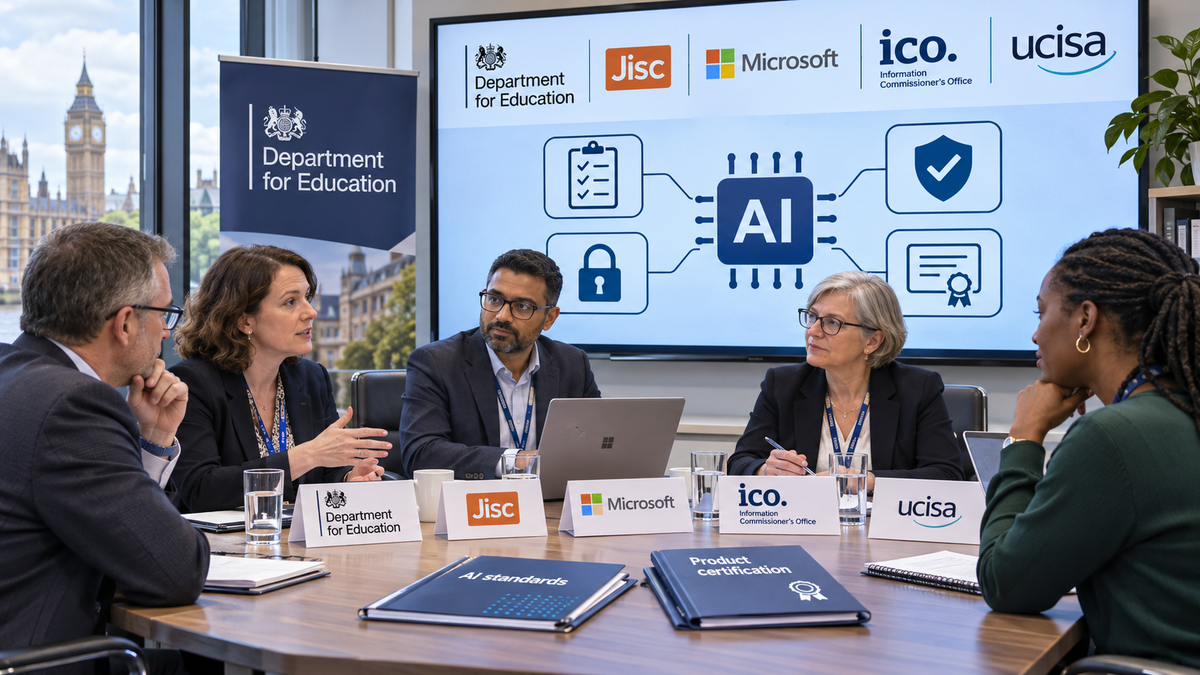
Jisc, the UK universities and colleges licensing body, is in talks with Microsoft over AI alongside the UK government and UCISA, I have learned. The DfE's EdTech and AI consultation opened November 10. The ICO has welcomed it and is in discussions with the DfE about a new EdTech code.

The 60-second Briefing
- Jisc has confirmed to The Digital Staffroom that it is in discussions with Microsoft over AI, "working alongside government and UCISA." Those discussions are ongoing and Jisc declined to comment further
- The ICO has publicly welcomed the DfE's new EdTech and AI product safety certification consultation and confirmed that it is in discussions with the DfE about a new EdTech code to protect children's data. The ICO directed me to the consultation page.
- The DfE consultation opened on November 10 and closes at 11:59pm on February 4 2027. A government response is due in spring 2027.
- The consultation proposes certification across four product categories: filtering products, EdTech conducting high-risk processing of children's data, pupil-facing generative AI tools, and pupil-facing personalised learning tools.
- Microsoft UK acknowledged an enquiry from this blog, but at the time of publication no substantive response had been received. The DfE is yet to respond.
- The AFT Standard, in effect in US school districts since November 1 2026, remains the only publicly documented contract-level AI protection model for schools globally. The DfE consultation does not refer to it.
Jisc, the UK higher education and further education licensing body, is in direct discussions with Microsoft over artificial intelligence in education, alongside the UK government and the Universities and Colleges Information Systems Association (UCISA), The Digital Staffroom has learned. The discussions have not previously been reported publicly, and they run in parallel with the Department for Education's consultation on an EdTech and AI product safety certification scheme, which opened on November 10 2026 and runs to February 4 2027.
The confirmation came in response to an enquiry on the UK sector's reaction to the AFT-Microsoft AI Safety and Privacy Standard for Schools, the contract Microsoft brought into effect for US school districts on November 1 2026. The AFT Standard provides US schools with six specific contractual protections on AI use that are not available in UK schools' Microsoft contracts. I reported on this in Mind the Gap on November 1 2026.
What Jisc has said
A senior press officer told The Digital Staffroom that Jisc is "currently engaged in discussions with Microsoft, working alongside government and UCISA regarding AI." They continued: "As those discussions are still ongoing, I am afraid we are unable to comment at this stage. However, I will ensure that we keep you updated once the discussions have concluded and we are able to share more information about the next steps."
Jisc is the UK higher education and further education licensing body. It negotiates the largest Microsoft contracts in UK education on behalf of universities and FE colleges. UCISA is the UK membership body for university and college IT leaders. Jisc has not identified which UK government department is participating in the discussions.
The ICO's comments
An ICO spokesperson also provided the following statement on Wednesday:
We welcome the Department for Education consultation announced this week on an EdTech and AI product safety certification scheme. We continue to work with the Department for Education and devolved authorities to improve how children's information is handled in schools. We are discussing with the Department how a new EdTech code could help protect children's data across the tools and platforms schools use widely.
The DfE consultation, published on November 10 2026, confirms that the ICO has a planned EdTech Code of Practice "which will be brought in following government regulations requiring production of the Code." The consultation states that "DfE is working with the Department for Digital, Culture, Media and Sport and the ICO" to ensure that the code and the certification scheme "operate coherently." The ICO's statement is the first public comment from the regulator itself on that work since the consultation opened.
The DfE consultation
The consultation seeks views on four categories of EdTech product that would be in scope for certification: filtering products; EdTech conducting high-risk processing of children's data; pupil-facing generative AI tools; and pupil-facing personalised learning tools. Products that would be out of scope include general office software, static content, hardware and infrastructure, and staff-facing tools without high-risk data processing.
High-risk data processing products that would fall in scope include AI tutoring tools, personalised learning systems, behaviour and safeguarding systems, SEND platforms, wellbeing and mental health platforms, and Management Information Systems (MIS). Learning Management Systems (LMS) would be in scope if they process special category data.
The scheme would be delivered by Conformity Assessment Bodies (CABs) accredited by the United Kingdom Accreditation Service (UKAS). The DfE's preferred ownership model is for the department to own the scheme and license delivery to one or more third-party organisations, with CABs responsible for individual certification decisions. Certified products would appear on a public register on GOV.UK, and suppliers would be able to display a certification badge.
Full product recertification would be required every three years for products in the filtering, high-risk data processing, and personalised learning categories. The consultation proposes annual recertification for generative AI tools.
Supplier obligations for products conducting high-risk data processing would include evidencing a Data Protection Impact Assessment, compliance with relevant data protection legislation, compliance with relevant ICO codes of practice including the Age Appropriate Design Code and the forthcoming EdTech Code of Practice, intellectual property compliance, and suitable cyber security measures "such as Cyber Essentials Plus certification."
Pupil-facing generative AI tools would additionally be assessed against the DfE's eight generative AI product safety standards:
- Filtering, Monitoring and Reporting
- Design and Testing
- Governance
- Cognitive Development
- Emotional and Social Development
- Mental Health
- Manipulation
The Manipulation standard requires that products "do not use manipulative or exploitative design features." The Emotional and Social Development standard addresses "the potential for emotional dependence." The Mental Health standard addresses "the potential for harm during mental health emergencies that are caused or worsened by interaction with generative AI tools."
The scheme would be technically non-mandatory. The DfE proposes to add an expectation to Keeping Children Safe in Education (KCSIE) and the Early Years Foundation Stage statutory framework that settings get "proportionate assurance" when procuring in-scope products, with certification "ordinarily" providing that assurance. The consultation proposes that Ofsted "could also have a role in supporting this approach through their consideration of safeguarding arrangements."
Subject to the outcome of the consultation, the DfE states that "a minimum of 18 months would be needed to establish the product certification scheme, before products could be certified, followed by a transition period to allow adoption by suppliers and education settings." The consultation does not give a target date for first certificates. Adding 18 months to the Spring 2027 government response would mean first certificates not before autumn 2028 at the earliest.
The consultation does not refer to the AFT Standard or to any other international precedent.
The AFT Standard
The AFT-Microsoft AI Safety and Privacy Standard for Schools is a set of six specific contractual protections for AI use in schools, negotiated between Microsoft and the American Federation of Teachers (AFT) with the United Federation of Teachers (UFT) also signing. The Standard took effect in US school districts on November 1 2026 and applies automatically to every existing Microsoft 365 Education contract without renewal or opt-in.
The six protections are: a prohibition on Microsoft selling "AI companion" products to schools; enhanced contractual remedies including the right to terminate the contract and seek damages; publication of the contract so US schools can see the terms their peers have; independent third-party audits of Microsoft's compliance, with the results published; plain-language transparency to families on how Microsoft AI tools use children's data; and a requirement for human sign-off on significant decisions made by AI.
The Standard sits above the Enterprise Data Protection (EDP) baseline that applies to UK institutional Microsoft accounts. Jisc confirmed in September 2024 that EDP applies to UK higher education institutions.
What happens next
The DfE consultation closes at 11:59pm on February 4 2027. The government response is scheduled for Spring 2027. If the scheme proceeds, a minimum of 18 months would be needed to establish it before first certifications could be issued, which would put first certificates no earlier than autumn 2028.
The Jisc-Microsoft discussions are ongoing. Jisc has not published a timeline for conclusion and has told The Digital Staffroom it will provide an update once discussions conclude.
I will update this piece if Microsoft UK provides a substantive response to my enquiry.
See you in the digital staffroom.