The Connected Court: Moneyball, Meritocracy & the Sports Hall
Pro-level sports tech is hitting school sports halls and it could genuinely transform PE teaching. Smart rackets, AI motion analysis, and auto-tracking cameras give pupils real autonomy over their own progress. The pedagogy is exciting; the IT plumbing just needs careful planning.

The 60-Second Briefing
- The University of Birmingham's partnership with the All England Open signals a move towards pro-level analytics in education. Tools like TrackNet and IMU-integrated rackets can turn the sports hall into a genuinely data-rich environment.
- It isn't just badminton; schools are increasingly adopting VEO auto-tracking cameras and Catapult GPS vests to give pupils elite-level performance data on their own technique.
- This kit moves the teacher from drill sergeant to tactical analyst and gives pupils real autonomy over their progress.
- 4K 60fps video creates serious data volumes. One camera eats ~45GB per hour; a four-camera setup can easily generate a terabyte in a single afternoon. Eminently solvable, but not by accident.
- Motion patterns used for identification are Special Category data. A proper Data Protection Impact Assessment (DPIA) is the price of entry.
Back in March I was following the YONEX All England Open in Birmingham, and it wasn't just the speed of the rallies that caught my eye. The University of Birmingham became the first university partner in the tournament's history, and they were not just there for the branding. They brought a level of "precision sensing" to the court that I think is genuinely exciting for our schools.
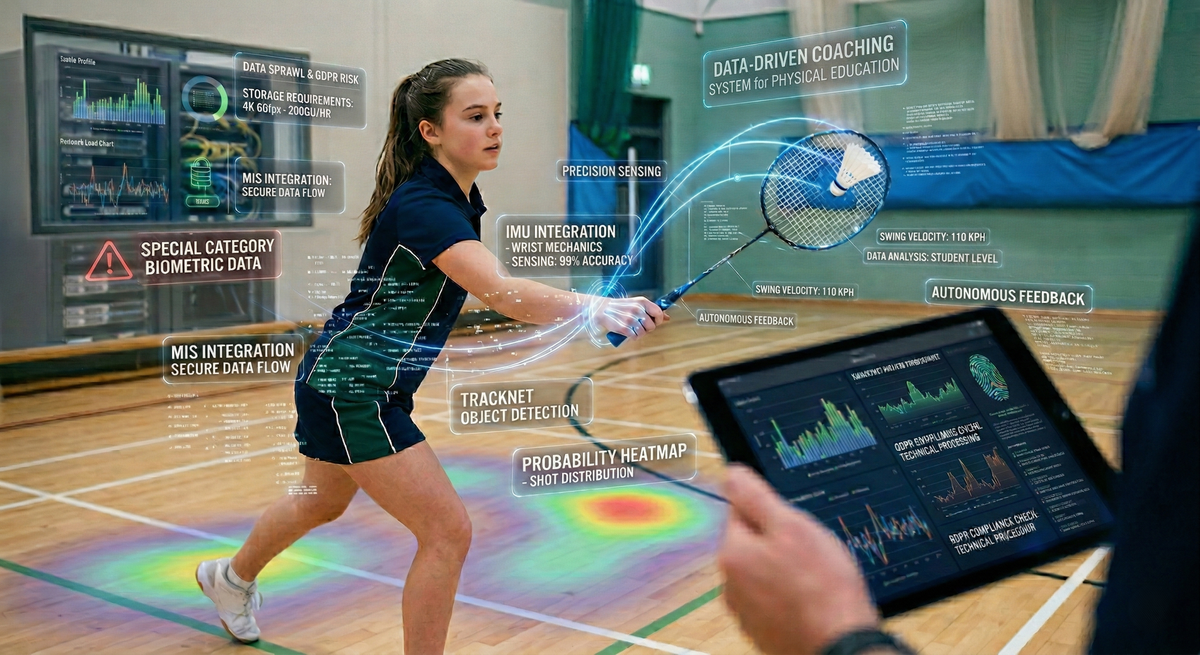
We are seeing Inertial Measurement Units (IMUs) integrated directly into rackets to track every micro-flick of a pupil's wrist. Pair that with TrackNet computer vision, and we are not just teaching pupils to hit a clear; we are teaching them to analyse a probability heatmap of their own movement. It is "Moneyball" for the GCSE PE cohort, and the pedagogical case for it is strong.
Now, I do know my way around a racket, although I'll admit cricket, football, and track were more my thing at school. With the knees starting to go, I am much more comfortable behind a dashboard than on a baseline these days. But as an IT Director, I find this kind of kit genuinely interesting to work with – it is one of the rare areas where the tech and the teaching pull in the same direction rather than fighting each other.
What this actually does for pupils
I was chatting about this with a couple of my school's PE teachers, one of them a seasoned badminton player who still has a mean smash. She is excited about the prospect of showing a Year 10 pupil exactly why they keep arriving at the shuttle late, using a highly accurate footwork overlay. Instead of saying "stay lighter on your toes," she can show the pupil their own movement, frame by frame, with their foot positioning mapped against the ideal recovery pattern.
That is a different kind of teaching. The pupil is not taking the coach's word for it; they are looking at evidence. They are participating in the diagnosis. And they are far more likely to internalise the correction because they spotted it themselves.
This is the real win. It is not the elite data, the polished first-team analytics, or the highlight reels. It is that "Aha!" moment when a pupil sees their own visual motion-chain and finally understands the physics of the game.
Technology in PE is sometimes dismissed as "lazy" or as a screen that gets in the way of actual exercise. Both of my PE colleagues pushed back on that view, and I think they are right to. When a pupil uses an app like PE Scholar or real-time video feedback, they gain autonomy. They stop looking to the teacher for every correction and start looking at the data themselves. It moves the teacher from a drill sergeant barking orders to a tactical analyst facilitating discovery. That is a genuinely better model of coaching, and it scales to pupils who would otherwise never get individualised technical feedback at all.
It isn't just badminton rackets that are getting smart. I am seeing more schools adopting VEO cameras for football and rugby, which use AI to follow the ball without a human operator. Others are deploying Catapult GPS vests to track player load and intensity, or Firstbeat Sports to monitor physiological recovery and heart rate. Each of these solves a real coaching problem that used to require either an expensive analyst or a lot of guesswork.
The other PE teacher I spoke to coaches football, and has been running VEO for a couple of seasons. He says two benefits stand out for him. The first is getting unbiased match footage without needing someone tied up with a camera all afternoon. The second is being able to show pupils what actually happened on the pitch rather than relying on what they thought happened – an argument that mirrors what his badminton colleague said about footwork at the other end of the school.
The pedagogical case is genuinely strong. The IT plumbing is where it gets interesting.
Where IT comes in
If your PE department decides to record every session at 4K 60fps – the minimum required for AI to track a shuttlecock reliably – your storage planning needs to be deliberate. A high-bitrate pro-sumer camera at 100Mbps generates roughly 45GB per hour. A four-camera setup pushes you to nearly 200GB per hour. A week of GCSE moderations can easily produce a terabyte that has to be stored, backed up, and retained according to your records policy.
None of this is a reason not to do it. It is a reason to plan for it properly.
The bigger architectural question is integration. Each of these platforms is fantastic in isolation, but they create a data island problem. As an IT lead, I want to know: how does this data flow back into the school MIS? Having pupil health and performance data scattered across six different proprietary clouds with six different login protocols is less than ideal, and it is exactly the kind of problem I described in Survival of the Leanest – six clouds, six logins, no spine.
Pull this together properly and the PE data becomes part of the whole-child picture, alongside attainment, attendance, and pastoral notes. Leave it siloed and you have an expensive collection of dashboards that nobody else in the school can see.
The other piece IT has to own is GDPR. Under UK GDPR, pupil biometric motion data is classified as Special Category data. This isn't just a video of a pupil playing sport; it is technical processing that creates a unique behavioural fingerprint. A proper Data Protection Impact Assessment is the price of entry, not a hurdle to clear afterwards. Done up front, it takes a week and protects everyone. Skipped and revisited after a complaint, it takes a term and looks much worse.
The meritocratic case
There is a genuinely meritocratic argument hiding in this technology, and I think it deserves to be made out loud. Elite-level technical coaching has, for most of the history of school sport, been a postcode and a price-tag issue. The pupil whose parents could afford a private badminton coach got individualised feedback on their footwork from the age of nine. The pupil who could not, did not, and made it to Year 10 still arriving late to the shuttle, with nobody able to spend the one-to-one hours required to fix it. That is not a story about talent. It is a story about access to feedback.
Kit like VEO cameras, smart rackets and motion-tracking platforms changes that calculus. A four-camera setup that records every match-play session, an app that breaks down a forehand swing frame by frame, an overlay that shows a pupil their recovery pattern against an ideal model. These tools, used well, give every pupil in the cohort the kind of technical diagnostic feedback that used to be reserved for the ones whose parents could afford it. The technology does not replace the coach, but it multiplies what a single coach can offer to a class of twenty.
I covered the Sutton Trust's findings in The Artificial Advantage, and the gap they document in AI training and strategy between sectors is real. The PE equivalent of that gap is older and quieter, but it has been there for decades. Sports tech, deliberately deployed, is one of the rare areas where well-judged spending in independent schools can narrow the gap rather than widen it – particularly where it sits alongside genuine outreach work with state-sector partners, shared facilities, and joint coaching programmes. The kit is most powerful when the pupils using it are the ones who would otherwise be locked out. That is the version worth building.
My advice to my peers this term? Don't buy it because it looks cool on a brochure. Buy it because it earns its place in your data spine.
PE is becoming a data-informed discipline, and that is genuinely good news. Pupils get better feedback, teachers get better tools, and the kid who never quite worked out why their serve kept catching the net finally has a way to see it for themselves. Our job in IT is to make sure the storage, the integration, and the data protection all hold up, so the PE staff can get on with the teaching.
The "Moneyball" era of school sport is here, and there is a lot to like about it.
See you in the digital staffroom.