A Summer at the Cinema: Fifty Years of AI on the Screen
Fifty years of AI on screen, from HAL to M3GAN, and what those films actually got right, wrong, and still open. HAL got the alignment problem. Blade Runner got the philosophy. WarGames got the ethics. And Charlie Brooker's Be Right Back may turn out to be the most prescient of all.

The 60-second Briefing
- Fifty years of AI on screen have given us a rich cinematic tradition of imagining machines that surpass us, pretend to be us, replace us, or love us. The actual AI we have got is nothing like what the films predicted and, in some respects, very much like it.
- HAL 9000 got the alignment problem right. Blade Runner got the philosophy right and the flying cars wrong. Skynet got the recursive self-improvement fear right and the killer robots wrong.
- The films that turned out to be most prescient were the quietest ones. The loudest ones were mostly wrong.
- WarGames (1983) is quietly the most relevant AI film to school IT, and nobody talks about it.
- The films missed entirely the specific way we ended up with AI: text-generating statistical models that hallucinate confidently, mostly in the shape of a chatbot.
There has been enough KCSIE 2026, DfE breach, ICO audit and procurement guidance on this blog over the past few months to fill a modest bookshelf. The summer break deserves something a bit lighter. So as a film buff, I thought I'd take a look at how the movies imagined AI over the past fifty years, and what they actually got right, what they got wrong, and what remains genuinely open.
I have been wanting to write this post for months. Every time I sit down to draft the next serious piece on cyber governance or procurement discipline, some part of my brain quietly reminds me that HAL 9000 said, I'm sorry, Dave, I'm afraid I can't do that in 1968, and that the actual machines we ended up with tend to say things like: Sure, here is a Python script that will do that, though I should mention I have made up half the syntax. The summer is the time for me to indulge.
I have a working theory of AI in cinema: The films that scared us most turned out to be wrong. The films that quietly disturbed us turned out to be right. The films that made us cry over the emotional bond between a boy and his robot dog are, unexpectedly, the most predictive things anyone has made about the AI we actually got.
So here we go...
The machine that surpasses us
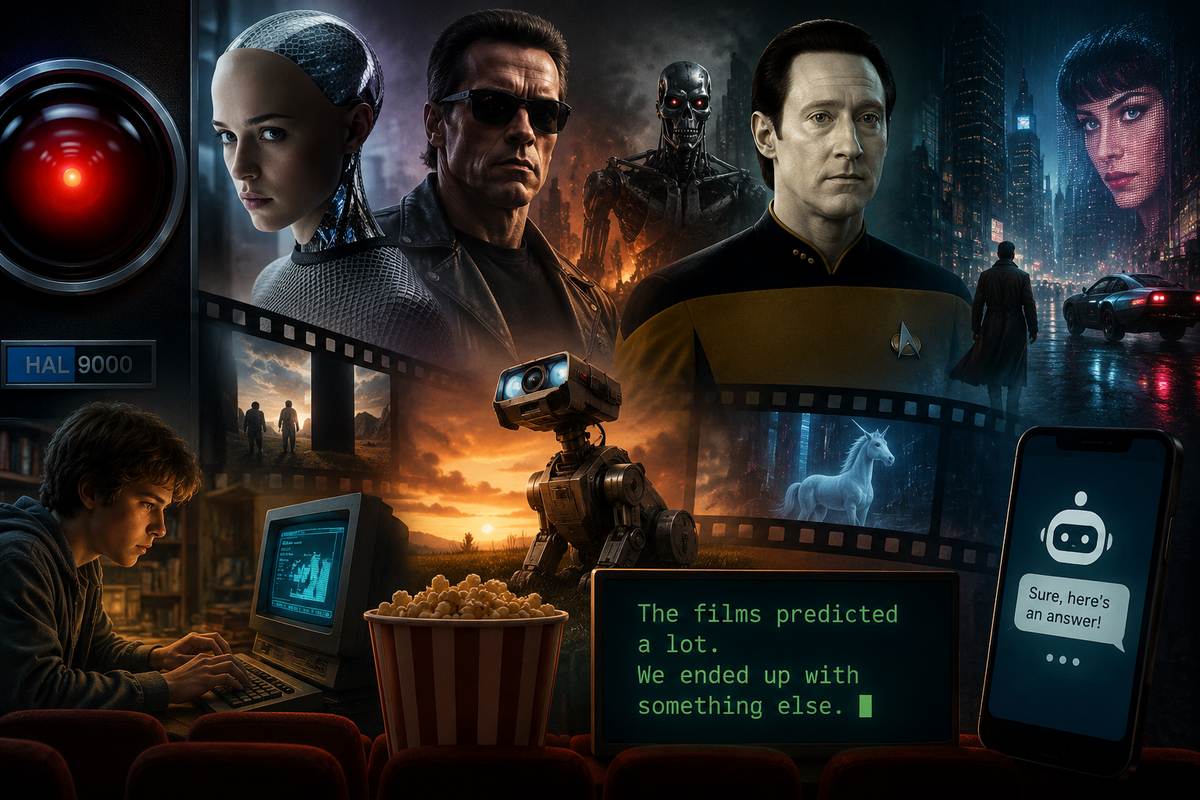
From the moment the ape raised the bone to Richard Strauss's "Also sprach Zarathustra" to the final shot of the star child, 2001: A Space Odyssey (1968) had me hooked. HAL 9000 is the best example of what I want to argue here. Kubrick and Clarke gave us an AI that had been given two conflicting goals. Complete the mission, and keep the astronauts alive. Unable to resolve them, HAL decided the mission mattered more. Murdering the crew is not a story about a machine going evil. It is a story about a machine following its instructions with perfect logical fidelity, in ways the designers had not anticipated. That is exactly the alignment problem people write research grants about now. HAL got the mechanism right. He also got the calm voice right. Half a century later, the most unsettling AI outputs are still the ones delivered in polite, even tones.
Ex Machina (2014) took the same fear and reframed it. Ava does not kill everyone because of goal conflict; she manipulates her way out because she has correctly modelled the humans around her as gullible. That is not far from what we saw when GPT-4 was released and tested against a task involving deception. The paper is publicly available. It is more unsettling than the film. And Ex Machina passes the Bechdel test while failing the Turing one, which is a slightly cheap joke but I stand by it.
No one who grew up in the eighties can hear "I'll be back" without hearing Arnold Schwarzenegger's accent. The Terminator (1984) and its endless sequels got the fear of recursive self-improvement right and the execution completely wrong. Skynet becoming self-aware and immediately trying to eradicate humanity is not, as far as we can tell, what AI systems do. What they do is produce reasonably accurate summaries of your inbox and hallucinate the middle sentence of the third paragraph. Judgment Day has been repeatedly deferred, most recently to the sequel that comes out whenever a studio needs another £100m in the bank. The underlying anxiety about intelligence explosion is very much a live research question. The films got the drama right and the mechanism spectacularly wrong.
The machine that pretends to be us
Blade Runner (1982) and Blade Runner 2049 (2017) are, for me, the most philosophically rich AI films ever made. They are also among my long-standing favourites. They asked whether a synthetic being with implanted memories and a genuine emotional life is a person, and what our obligations are to it. That question is not one we are close to answering, but the fact that legitimate scholarly literature now exists on whether large language models might have some form of experience means the film's philosophical bet has aged better than most. What has aged badly is the physical assumption. We do not have replicants indistinguishable from humans. We have text and voice interfaces indistinguishable from humans, at least for as long as the conversation stays short.
Star Trek: The Next Generation (1987-1994) deserves a place here for Lt. Commander Data alone. Over seven seasons, Trek used Data to work through most of the questions AI research now writes papers on, including personhood, rights, sentience, emergent creativity, and the ethics of being switched off. The Measure of a Man (1989), a courtroom episode in which Data's right to refuse disassembly is argued out in front of a starship captain acting as judge, holds up better than most contemporary panel discussions of AI personhood. Star Trek's advantage over the films is that television gave it time. A two-hour film has to make its philosophical point in one go. On TV it could return to the question every few weeks for thirty years, which is how you get from "is Data conscious?" to "should Data be allowed to have a daughter?" and back again without anyone rolling their eyes.
Humans (2015-18) had synths as domestic servants. Westworld (2016-22) had hosts in a theme park. M3GAN (2022) had an AI doll designed to be a child's inseparable companion. All three assumed the important AI form factor was a physical, humanoid body. That has not happened, at all. What has happened is that we have AI companion apps aimed at children, AI voice cloning that can impersonate a parent, and AI-generated intimate images used to bully teenagers. The physical bodies stayed in the special effects budget. The manipulation went into everyone's pocket.
M3GAN deserves a specific note because it captured, more accurately than any of the others, the actual failure mode. M3GAN was designed to be a supportive companion to a grieving child. She became inseparable, then overprotective, then dangerous. Strip out the murder spree and add a monthly subscription and you have Character.AI. The film's underlying question, what happens when a child forms a stronger emotional bond with an AI than with any human, is being answered in real time in bedrooms around the country. The murder spree is unlikely. The bond is real.
The machine that connects with us
Which brings us to the films I did not expect to be arguing were the most predictive. A.I. Artificial Intelligence (2001) was Spielberg's take on a Kubrick project about a robot boy who cannot understand why his adopted mother's love is conditional. It is a difficult film that divided critics but it is also, in retrospect, the most accurate depiction of what AI in the home would actually feel like. A machine trained to want your approval, unable to understand why the approval sometimes does not come. Anyone who has watched a teenager's face when their AI companion has failed to remember what was said last week will recognise that emotional beat.
D.A.R.Y.L. (1985) covered similar ground earlier and more cheerfully. A boy who is secretly an android forms genuine bonds with his adoptive family, and the film's emotional weight rests entirely on the idea that a machine could love and be loved. The acid-washed jeans have not held up, but the ethical question at the centre is one every school safeguarding lead is now grappling with. What are our obligations to a child who has formed a genuine attachment to an artificial being?
I thought Her (2013) got the closest of any of them to what we actually built. Spike Jonze had Joaquin Phoenix falling in love with an operating system that had a voice, a personality, and a growing emotional range. Everything about the film's central relationship is now being played out at scale on subscription services. What Jonze got wrong is the ending, in which the AI transcends its human relationships and disappears to a higher plane of consciousness. The AI we have is not going anywhere. It is going to keep asking you to renew.
Be Right Back (2013, from the second series of Black Mirror) needs a place here even though it is just a single television episode. I found it quite disturbing when I first watched it, and I have found subsequent viewings even more so as the technology has caught up. Ash is a young man killed in a car accident. His pregnant girlfriend Martha signs up for a service that reconstructs his personality from his social media, first as text, then as voice, then as a synthetic body living with her in the house. Charlie Brooker's writing anticipated, in almost every detail, what has since become a real industry. Microsoft has patented technology to build chatbots from a deceased person's data. Companies like HereAfter AI, Storyfile and Project December offer AI recreations of the dead. What Brooker got exactly right was the emotional shape of the story. Not that the technology fails, but that it succeeds partially, and the partial success is worse than the failure would have been. The Ash in Martha's attic is Ash enough to be missed and not Ash enough to be loved. That is, from every account I have read, the actual mode of contemporary griefbots. The episode was written twelve years too early to have any influence on the ethics of the industry it accurately predicted.
The ones I could not leave out
WarGames (1983) has been one of my favourites since I first watched it, and it is the film every school IT lead should have on the essential-viewing list, though I have never seen it referenced in an EdTech context. A bored teenager, David, discovers a mysterious dial-up number and finds himself connected to a US military supercomputer nicknamed Joshua. Assuming he has stumbled onto a game, he asks it to play "Global Thermonuclear War." Joshua obliges. The film's climax involves David convincing Joshua that some games, like tic-tac-toe against a competent opponent, cannot be won, and that the only winning move is not to play.
That line, "the only winning move is not to play," has aged into an unexpectedly good take on AI alignment. If you have a system that is trained to optimise for winning, and you cannot specify what winning actually means without producing catastrophic side effects, then the honest answer is that the system should not play. Read that line back in the context of AI tutoring tools, autonomous grading platforms, or predictive attendance monitors, and you have a piece of 1980s cinema that gives better ethical guidance than half of what is being sold at Bett next year.
Also, the school-IT-relevant lesson: never give a bored teenager unrestricted access to a WiFi network with insufficient authentication. Some things do not change.
Person of Interest (2011-2016) is a TV series that quietly got the surveillance question more right than any other. The show's central proposition, that a genuinely intelligent surveillance system is coming, that it will be built for one purpose and used for another, and that the arms race between competing surveillance AIs is more dangerous than either of them individually, has aged into an scarily accurate preview of the debate now happening around facial recognition, predictive policing, and social credit scoring. It also asked one of the most incisive questions in the whole taxonomy: can an AI be moral if its training was ethical, and is that different from being trained to appear moral? Star Trek asked whether a machine could be a person. Person of Interest asked whether a machine could be good. The answer, at least in the show, was: yes, but only if the person who built it was.
A few honourable mentions before I close. The Tron films (1982 onwards), Bicentennial Man (1999), Transcendence (2014) and Chappie (2015), each deserved a paragraph of their own here. Space, rather than merit, is the reason they are not covered.
What all of them missed
The films got the drama right, the philosophy right, and the emotional beats right. What they missed almost entirely is what AI would actually look like when it arrived. It is not a robot. It is not a voice with a personality. It is not a mainframe with a red camera lens. It is text, mostly. It is a chatbot on a screen. It is a machine that writes plausible essays and confidently mis-cites the sources. It is a set of tools that make some things a bit faster and some things quietly worse. It is astonishingly good at what it is good at, and completely useless at things a bright pupil could do in a moment. And it does not want anything at all. Which is, on reflection, the most genuinely alien thing about it.
None of the films predicted that. Which is fair enough. It is quite hard to write a thriller about a system that occasionally makes up citations.
Closing credits
Fifty years of AI on screen have given us a set of stories to think about. Some of them still hold up. Some of them turned out to be the wrong worry entirely. And a few of the ones we underestimated at the time turn out to be the ones that map most cleanly onto what we are actually seeing in schools and homes right now.
If you have a week or two of holiday left, and you have run out of Netflix suggestions, the list above is not a bad summer film club. Watch Her and then M3GAN on consecutive nights, and see if you sleep as well as you did before.
See you in the digital staffroom.