The Digital ISP: Navigating the New SEND Reforms
The government's Schools White Paper introduces a £4 billion SEND overhaul, replacing most EHCPs with statutory digital Individual Support Plans. For IT Directors, this means solving complex data integration, security, and assistive technology challenges to prove our inclusive value.

The 60-Second Briefing
- The Policy Shift: The new government White Paper outlines a £4 billion reform of the SEND system, shifting away from EHCPs for all but the most complex cases.
- The Digital ISP: Schools will now be legally required to create and maintain a live, digital "Individual Support Plan" (ISP) for every pupil with identified additional needs.
- The Funding Squeeze: State schools are receiving a £1.6 billion "Inclusive Mainstream Fund," while independent special schools are facing strict new national price bands to curb fees.
- The Infrastructure Challenge: IT Directors must figure out how to securely integrate these live, collaborative digital ISPs into existing Management Information Systems without creating a data silo or overwhelming teachers.
The Department for Education (DfE) dropped its massive Every child achieving and thriving White Paper last week. At over 100 pages, it is a dense blueprint for the next decade of education. While a lot of the debate has so far been around the politics of academy trusts and breakfast clubs, the real earthquake for school operations is buried in the operational details of the £4 billion overhaul to the Special Educational Needs and Disabilities (SEND) system.
The government is orchestrating a fundamental, generational shift in how we track, fund, and support pupils with additional needs. They are aggressively moving away from the adversarial, bureaucratic nightmare that is the current Education, Health and Care Plan (EHCP) system. In its place, they are mandating a highly inclusive, data-driven approach centred around a brand new piece of digital infrastructure.
As an IT Director, I view policy documents through a different lens than a Headteacher or SENCO. When politicians promise "seamless collaboration" and "transparent data," I immediately start worrying about APIs, access controls, and the potential load on resources. And the introduction of the digital Individual Support Plan (ISP) is about to test all of those to their limits.
Integration Nightmare or Data Saviour?
The headline policy of the SEND overhaul is that EHCPs will now be reserved strictly for children with the most severe and complex needs, utilising new "Specialist Provision Packages". For the vast majority of the 1.7 million children in England with SEND, support will now be managed via a digital Individual Support Plan.
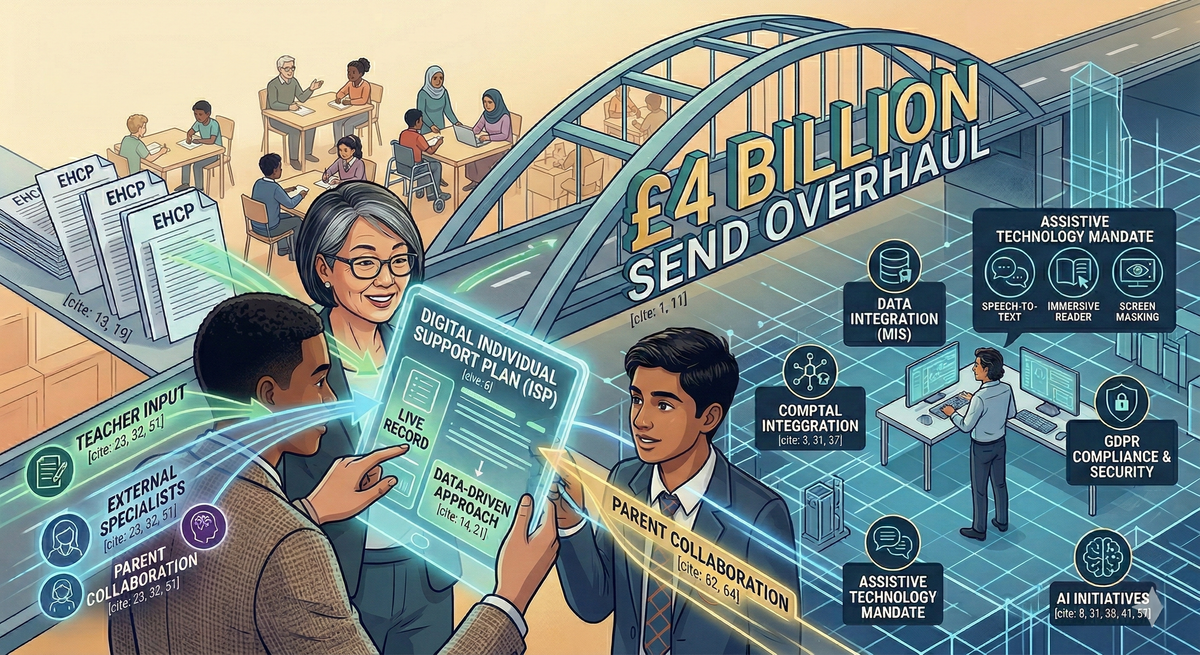
This ISP is designed to be a live, statutory digital record. It will detail a pupil’s specific barriers to learning, the day-to-day provisions required in the classroom, and the intended outcomes. Notably, it must be developed and continuously updated in active collaboration with teachers, external specialists, and parents.
A few years ago, as Chair of Governors at a state school, I saw first-hand the challenges faced dealing with SEND issues. I watched dedicated staff and exhausted parents battle an adversarial system just to secure basic provisions for vulnerable children. So, on paper, this shift is a great idea. It aims to tear down the walls that force parents to fight local authorities for basic support. But in the digital staffroom, this raises glaring practical questions about systems architecture.
How exactly are these digital ISPs going to integrate with our existing infrastructure? In a modern independent school, we already juggle a complex web of platforms. We have our core MIS, our safeguarding software (like CPOMS or MyConcern), our academic trackers, and our parent communication portals.
If the government mandates a specific, centralised national platform for these ISPs, we are going to face massive data silos. Teachers are already drowning in administrative workload. If we ask them to log an intervention in the school MIS, write a pastoral note in the safeguarding system, and then log into a separate DfE portal to update a digital ISP, the system will collapse under the weight of its own bureaucracy.
Alternatively, if the DfE expects EdTech vendors to build ISP modules directly into existing MIS platforms, we are looking at significant procurement costs and a frantic scramble for API interoperability. Furthermore, opening a live digital document to continuous input from a multi-agency team – teachers, speech therapists, educational psychologists, and parents – requires watertight access controls. We have to ensure absolute data security and GDPR compliance without creating a system so locked down with multi-factor authentication that it becomes entirely useless for daily classroom teaching.
The Assistive Technology Mandate
The technological implications of the White Paper go far beyond data entry. The government’s clear goal is to keep more SEND pupils in mainstream education rather than relying on expensive specialist schools. To achieve this, they are launching a £1.6 billion "Inclusive Mainstream Fund" over the next three years, paid directly to schools and colleges to fund early interventions and adaptive teaching.
For IT, "adaptive teaching" is synonymous with assistive technology. The DfE has explicitly stated that effective use of technology and AI can make a real difference, and they are even piloting assistive technology lending libraries and providing free national online training for teachers.
This means assistive technology can no longer be viewed as a niche installation on a handful of laptops. Features like advanced speech-to-text, immersive readers, screen masking, and live closed-captions must become ubiquitous across your entire network. They need to be standardised across every device, easily accessible in every classroom, and seamlessly integrated into the daily workflow of the school. If a pupil requires a digital reading aid as part of their new ISP, the IT infrastructure must deliver it without friction or latency.
The Squeeze on the Independent Sector
If you work in the independent sector, you might assume that state funding announcements do not apply to you. But the SEND overhaul contains a very sharp stick for private schools.
The government has announced a severe crackdown on independent special school fees, introducing national price bands and minimum service standards to end what the Education Secretary called "runaway" costs and "unreasonable bills for local authorities". They are explicitly targeting private equity-backed providers who they accuse of putting profit before children.
While this regulatory heavy hand is aimed primarily at specialist provisions, the shockwaves will be felt across all mainstream independent schools. The state sector is about to receive an enormous injection of cash. Alongside the £1.6 billion mainstream fund, there is a £1.8 billion "Experts at Hand" service being deployed to give state schools on-demand access to speech therapists and educational psychologists.
The baseline for what constitutes a "good" inclusive education is being radically raised. If local state schools are armed with robust digital ISPs, state-of-the-art assistive tech, and on-demand specialists, independent schools must ask themselves a difficult question: how do we justify our fees? Our digital infrastructure cannot just be adequate; it has to be exceptional. We must proactively demonstrate that our digital ecosystem provides a superior, more personalised, and highly secure environment for neurodivergent pupils and those with specific learning needs.
The Scrutiny of AI in Education
As we race to implement these changes, we must also navigate the rapidly evolving landscape of AI. Just days after the White Paper was published, the cross-party Education Select Committee launched a major new inquiry into the role of AI and EdTech in schools.
They are specifically looking at whether AI tools perpetuate inequalities or if they can successfully support students safely. With the DfE already tendering a £1.5 million project to co-create AI tutoring tools designed to close the attainment gap, AI is clearly going to play a massive role in delivering the interventions prescribed in these new ISPs. IT Directors will be tasked with vetting these tools, not just for network security, but for pedagogical efficacy and algorithmic bias.
The new White Paper has handed the education sector a bold, inclusive blueprint. The politicians have made the promises, but blueprints do not build themselves. Over the next few years, it will be the IT teams, working closely with SENCOs and pastoral leads, who will have to lay the digital bricks and mortar. We have to turn the political promise of the digital ISP into a secure, functioning reality.
See you in the digital staffroom.