Curiosity vs. the Clock
As British Science Week celebrates "Curiosity," a 15-year-old’s AI breakthrough in cancer research challenges the "lazy" narrative of the digital age. The 2026 Stripe Young Scientist winners and LSE's research demonstrate why raw "screen time" is an outdated metric that obscures student brilliance.

The 60-Second Briefing
- The Power of Curiosity: Marking British Science Week 2026, pupils are proving that the digital estate can be a launchpad for scientific inquiry rather than just a distraction.
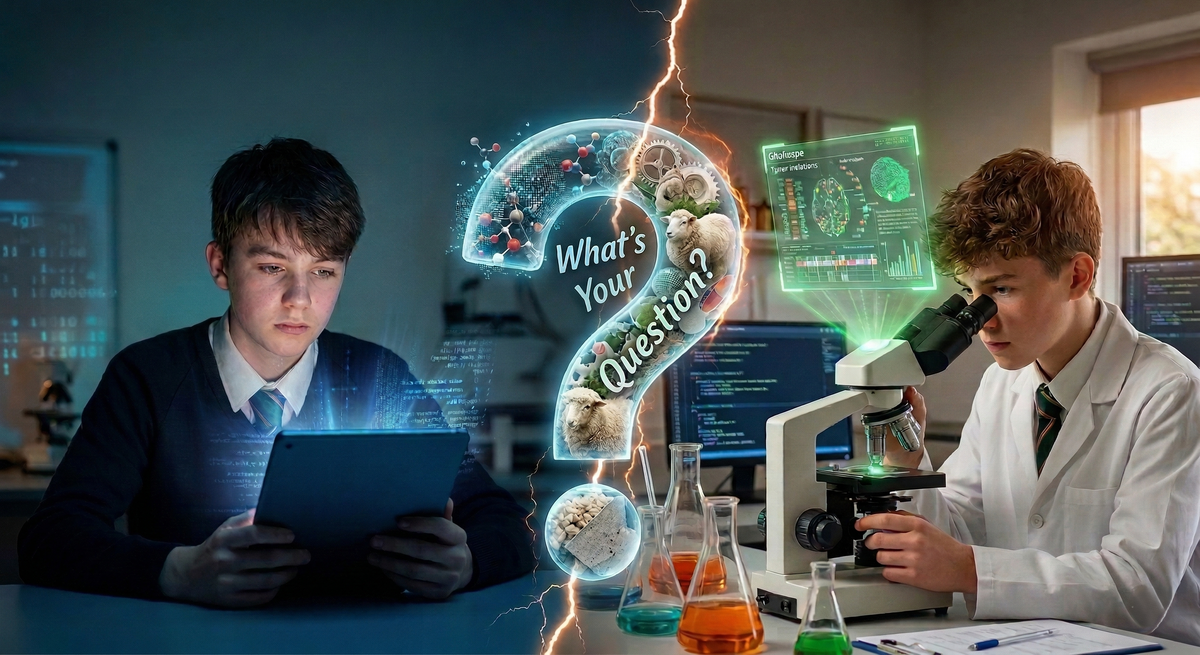
- A Clinical Breakthrough: Aoibheann Daly, 15, won a 2026 Stripe Young Scientist Award by building GlioScope, a tool using causal AI to profile aggressive brain cancer from MRI scans.
- The Cognitive Alarm: In contrast, recent testimony from neuroscientists before the US Senate warns that indiscriminate device use is causing Gen Z to underperform on nearly every cognitive measure.
- The LSE Nuance: Research from the London School of Economics (LSE) argues that "screen time" is a flawed metric that fails to distinguish between passive scrolling and purposeful creation.
If you look at the flickering blue light reflecting off the faces of a class of Year 9s, what do you see? Some see the death of deep thought, a generation whose internal hard-wiring is being rerouted by dopamine-driven algorithms. Others see a room full of potential explorers, equipped with more computational power than the researchers who put a man on the moon.
I often feel like I am managing the collision between two entirely different digital worlds, a paradox that sits at the heart of British Science Week 2026, which this year focuses on the theme of "Curiosity: What’s Your Question?"
I was chatting to some pupils from my school's Robotics Club yesterday, and if you want to see what "intentional technology" looks like in the wild, these were the guys. It was impossible not to get caught up in the obvious enthusiasm of the pupils as they debated sensor logic and torque ratios. It is no surprise they are off to the VEX World Championships in St. Louis next month; their work is the ultimate rebuttal to the idea that digital tools are making our children "lazy".
The Case for Cognitive Caution
I have written before about my support for the mobile phone ban in schools. I still believe that removing personal distractions is fundamental to a calm learning environment. But while concerns around distracting tech are entirely valid, the issue is a lot more nuanced than the polarised debates or raw statistics suggest.
That said, we cannot ignore the alarming data landing on our desks recently. During a recent hearing before the US Senate Committee on Commerce, Science, and Transportation, neuroscientist Dr. Jared Cooney Horvath delivered a sobering message: Gen Z is the first generation in modern history to underperform their predecessors on almost every cognitive measure, from basic attention to executive functioning. Horvath attributes this directly to the widespread, unregulated adoption of digital technology in schools, arguing that we are essentially allowing pupils to offload their thinking to machines before they have learnt how to do it themselves.
The AI-Powered Response
Just as I was getting ready to double-lock the laptop trolleys, however, I read the results of the Stripe Young Scientist & Technology Exhibition 2026. The overall winner, fifteen-year-old Aoibheann Daly from Kerry, didn't spend her time mindlessly scrolling or offloading her homework to a bot. She spent it building GlioScope, a multitask deep learning tool that can profile genetic mutations in brain cancer tumours using only a standard MRI scan. Her curiosity led her to solve a clinical problem that usually requires invasive, slow, and expensive brain biopsies.
This is not just an isolated case of a one-in-a-million digital genius. Individual runner-up Joshua Corbett used machine learning to navigate a hundred million billion nanoparticle designs for drug delivery administered through the nose. These pupils are not just "on a screen"; they are using a digital laboratory to tackle the most complex questions in modern medicine. They are living embodiments of the British Science Week theme, using their digital access to ask questions that could save lives.
Ditching the Clock for the Content
This brings me to the nuanced findings of the London School of Economics (LSE) research led by Professor Sonia Livingstone. Her team has long argued that "screen time" is an unhelpful, blunt instrument of a term that fails to distinguish between different types of engagement. It makes no distinction between a pupil mindlessly scrolling through social media and one using our high-speed internet connection to research sustainable material science or physics-based models of the early universe. The LSE study suggests that the impact of digital engagement depends entirely on "content, context, and connections" rather than just the arbitrary number of hours on a clock.
It is also worth noting that innovation in our schools is not always exclusively digital. The Best Group winners this year, Aoife Fadian and Jessica O’Connor, looked at local resources to prove that sheep’s wool could be used to reinforce concrete for more sustainable buildings. This serves as a vital reminder that curiosity doesn't always need an API; sometimes it just needs a fresh look at the world around us. However, in most cases, the research phase of these brilliant projects is powered by the very connectivity we often treat as a threat to pupil focus.
I am not dismissive of the serious cognitive concerns raised by Horvath and others. Far from it. Proponents of tech restrictions are right to worry about the displacement of sleep and the erosion of the deep focus required for sustained thought. But the lesson for those of us in the digital staffroom is that we have a duty to move past the binary "ban vs. allow" shouting match. If we focus exclusively on banning the tool, we risk extinguishing the very curiosity that our science departments are trying to ignite this week.
Architecting Intentionality
In the independent sector, we have the unique resources to move from being drill sergeants enforcing bans to data coaches facilitating high-level inquiry. Our job is to provide the infrastructure and the statutory safeguarding that protect their data while giving their curiosity a platform. The best strategy for 2026 is one of intentional technology – making sure we are not just fixating on the clock while our pupils are busy building the future.
See you in the digital staffroom.