Banning Devices, Building Minds
It is easy to feel like you are standing in the middle of a see-saw, balancing the "ban it" brigade against the "innovate now" evangelists. But if you look closer, there is a coherent strategy emerging. We are moving towards a model of Intentional Technology.

Read time: 5 mins
The 60-Second Briefing
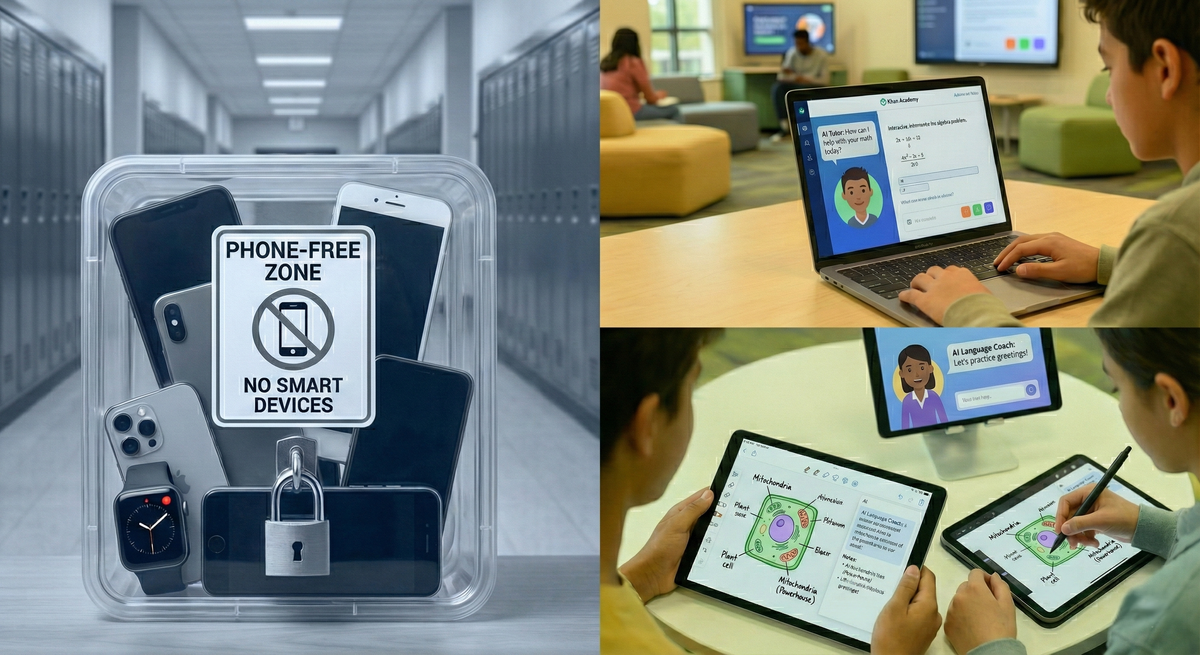
- The Phone-Free Hardline: The DfE has updated its guidance to be explicit: schools must be phone-free all day, including breaks. This now includes smart technology like Apple watches.
- The AI Tutoring Tender: The government is procuring AI tutoring for 450,000 disadvantaged pupils. This sets a new baseline for personalised learning that independent schools must match or exceed.
- The Socratic Shift: Google and Khan Academy have launched a tool that guides students rather than giving answers. This is the anti-cheating AI we have been waiting for.
- Your Move: Review your BYOD policy for smartwatches and start trialling "coaching" AI tools before parents start asking why the state sector is ahead of us.
It has been a month of mixed messages in the educational technology world.
If you looked at the headlines this past week, you would be forgiven for suffering from a bit of whiplash. Last Monday, the Department for Education (DfE) told us to lock devices away. The next day, they announced a massive tender to put AI tutors in front of 450,000 children.
It is easy to feel like you are standing in the middle of a see-saw, balancing the "ban it" brigade against the "innovate now" evangelists. But if you look closer, there is a coherent strategy emerging. We are moving towards a model of Intentional Technology.
The devices that distract (phones) are being evicted. The tools that personalise (AI tutors) are being invited in.
Here is what you need to know about this week’s policy shifts and what they mean for your strategy.
It’s Not Just Phones Anymore
We knew this was coming, but the DfE’s updated guidance on mobile phones, released alongside the Bett show, is firmer than many expected.
The headline is "phone-free by default." This isn't just for lessons; it covers the entire school day, including break and lunchtimes. And Ofsted has been instructed to inspect this immediately.
But the detail that will cause headaches for IT Directors (and Housemasters) is the inclusion of "smart technology with similar functionality."
That means smart watches.
For years, we have operated in a grey area with wearables. We banned the iPhone 15 in the blazer pocket but ignored the Apple Watch Ultra on the wrist. That loophole just closed.
If a device can receive notifications or send messages, it falls under the ban.
The Strategic Implication: If you run a BYOD scheme, you need to audit your Acceptable Use Policy immediately.
Does your policy explicitly distinguish between a "learning device" (laptop/tablet) and a "communication device" (phone/watch)? If not, you are open to challenge.
Furthermore, this is a network visibility issue. If students can’t use their phones, they will try to bridge their laptops to personal hotspots or use VPNs to bypass filtering on the school network.
My advice? Tighten your WiFi restrictions this week. Make sure your filtering can detect and block VPN protocols, because the attempts to circumvent the firewall are about to skyrocket.
The State-Sponsored AI Tutor
While they are taking the phones away, the government is handing out AI.
The DfE announced a tender to provide AI-powered tutoring to 450,000 disadvantaged pupils. This is part of the broader £23 million investment in evidence-based EdTech.
Why does this matter to us in the independent sector?
Because it sets a new baseline for parental expectations.
Historically, independent schools have sold themselves on small class sizes and individual attention: "We spot the struggling student before they fall behind."
But if the state sector successfully deploys AI tutors that offer 24/7, personalised, one-to-one coaching for free, that value proposition comes under pressure.
If a state school student has an AI coach that knows their weak spots in quadratic equations and feeds them custom practice questions at 8 PM, and our students just have a textbook and a prep session, who is getting the better deal?
We cannot ignore this. We need to be piloting these tools now. We need to show that we are not just resting on the laurels of our human staff, but augmenting them with the best digital tools available.
The Death of the Cheating Machine?
I promised I wouldn’t just bring you problems. The best news to come out of the sector last week is the partnership between Google and Khan Academy.
For two years, we have been fighting a losing battle against generative AI. Students paste the essay prompt, ChatGPT writes the essay, and we waste hours trying to prove it.
The new Gemini-powered Khanmigo features represent a shift to Socratic AI.
When a student asks this AI to "write my essay on Macbeth," it refuses. Instead, it asks: "What is your central argument about Lady Macbeth’s ambition?"
It acts like a good teacher. It prompts, it nudges, it questions. It forces the student to do the thinking.
This is the holy grail. It transforms AI from a plagiarism engine into a pedagogical tool.
Even better, Google is building this directly into Workspace for Education. It includes "process transparency," allowing teachers to see the evolution of a document.
If you can see that a student spent three hours interacting with the AI coach, drafting and redrafting, you don’t need a plagiarism checker. You have proof of learning.
Conclusion: Boundaries and Bridges
The theme of the week was boundaries.
We are drawing a hard boundary around the social, distracting technologies that harm our students' attention spans.
But we are building a bridge to the technologies that can deepen their understanding.
My advice for your next SLT meeting? Don’t let the phone ban conversation dominate the agenda. Say yes to the ban, fix the policy, and move on.
Spend your political capital on the AI tutoring pilot. That is where the future of our sector lies.
See you in the digital staffroom.